A New Perspective on the Minneapolis Skyway
For the past few years, I’ve assumed that the Minneapolis skyway system held the title of the world’s largest contiguous pedestrian bridge network. Civic boosters and travel influencers have long touted this claim, but it turns out that my assumption was incorrect.
I recently learned that the KAFD Skyway Network in Riyadh now holds the Guinness World Record for the largest contiguous pedestrian bridge network, with a length of 9.6 miles. This is just slightly longer than our reported 9.5 miles. A spokesperson from Guinness confirmed that the Riyadh network has surpassed us.
This news came as a surprise, and it’s been tough to swallow. Adam Duininck, president and CEO of the Minneapolis Downtown Council, described the situation as “incredibly disappointing.” The Minneapolis skyway system, which once thrived as a vibrant part of the city, has seen a decline in recent years. Urban enthusiasts have called for its removal, and many retailers and major office tenants have left since the pandemic began.
However, I recently had the opportunity to explore the skyway system with fresh eyes, and I found myself appreciating aspects of it that I had previously overlooked.
Discovering Hidden Gems
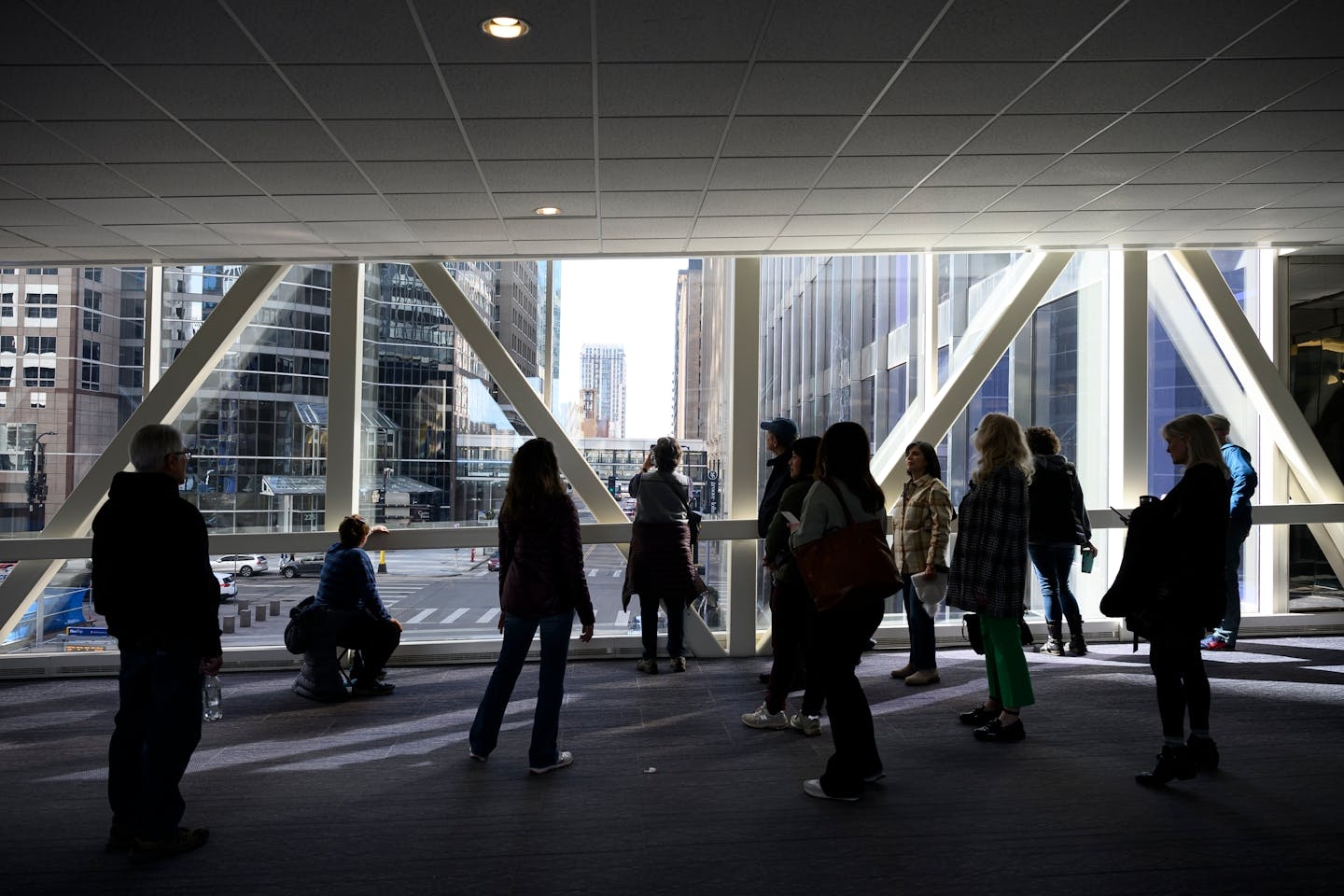
Urban explorers can experience the hidden gems of the Minneapolis skyway through an excursion offered by Minneapolis Community Education, an extension of the public school district. On the inaugural tour, participants included a diverse group ranging from international transplants to long-time residents.
I joined the tour because my knowledge of the urban labyrinth was limited to a well-worn path between where I park, work, and occasionally enjoy a $15 salad. Venturing beyond that path often felt like navigating a sea of empty storefronts, interrupted by delicious-sounding sushi joints and Cardigan doughnut shops.
Guide Jessica Schugel, owner of Mpls City & Skyway Tours, noted that many people who work downtown are familiar only with their small section of the skyway. She believes that people are too busy or distracted to explore further, viewing the elevated paths as a means rather than a destination.
A Changing Perception
While some critics ridicule the skyways, blaming them for siphoning off potential street-level bustle, Schugel doesn’t share this view. She argues that the skyways don’t necessarily detract from street life, pointing out that they are fantastic for cold winter days and pleasant during summer when temperatures soar.
Schugel is optimistic about the future of the city’s core, highlighting the second-story offerings of public art, shops, restaurants, and views of period-specific urban architecture. The next community ed class is already sold out, but interested individuals can sign up for a roughly 2-hour tour through Schugel’s website at minneapoliscitytours.com; it costs $75 per person.
Surprises Along the Way
During the tour, I discovered several interesting facts about the skyway system:
- The preserved terrazzo flooring in the city’s oldest skyway, spanning 7th Street and linking the Northstar and Baker centers, dates back to 1963. It was the city’s second skyway, with the first one constructed a year earlier less than a block away, later demolished to make way for what is now known as Wells Fargo Center.
- Developer Leslie Park envisioned the skyways as a means to compete with suburban shopping centers and retain downtown vitality. Southdale Center, the country’s first indoor mall, opened in Edina in 1956, while General Mills moved its corporate headquarters from downtown to Golden Valley in 1958.
- Viola Frey, a late California ceramicist, created “Fallen Man II,” a sculpture of an office professional sitting sullenly in the basement of 60 South Sixth. This colorful piece offers a break from the fluorescent lights and cube farms typical of office environments.
- U.S. Sen. Amy Klobuchar, who is running for governor, was named “Ms. Skyway” by the now-defunct newspaper Skyway News in March 1988. As Ms. Skyway, she won a dinner for two at Murray’s, a full-service car wash at Nicollet Car Wash, and one month of Jazzercise classes. She also received 12 helium balloons.
- The Stock & Bond restaurant, which opened last year in the Westin, features an opulent design visible from a second-story overlook. Its lavish design includes a 33-foot-long ceiling mural depicting a banker and a mechanic, created by artist Aaron Petz to honor hardworking Americans.
- The Public Service Building, built in 2021, houses impressive large-scale art installations, including a series of six window murals by Dakota artist Marlena Myles. Tristan Al-Haddad’s installation “Current Conditions” uses 98 chains to represent temperature and humidity data, shifting across the ceiling throughout the day.
Looking Ahead
Despite its deceptively bland name, the Minneapolis skyway system was once a source of pride, a sense of place, and evidence of Minnesota ingenuity. Duininck, of the Downtown Council, emphasized the need for ideas to infuse the skyway with energy and creativity.
Downtown workday foot traffic on the street and skyway levels has rebounded to about 80% of pre-pandemic levels on Tuesdays, Wednesdays, and Thursdays, when most office workers are downtown, he added.
All is not lost. From a new Minneapolis map app for the chronically lost to a first-of-its-kind 5K race in St. Paul, people are still betting on better days for the skyways.
There’s still a lot to love about the Minneapolis skyway, the largest contiguous pedestrian bridge network in North America.
“Like any good-spirited Minnesotan or Minneapolitan, seeing that we’re in second place will somehow motivate us to get into first,” Duininck said.