A Unique Celebration of Americana in Prague
The sound of nearly 1,000 motorcycles echoes through the hot mid-summer air, mingling with the scent of grilled meat. The ground trembles as a heavy metal tribute band plays set after set, drenched in sweat. Car enthusiasts gather to take photos of the ’57 Chevrolet Bel Air “Blue Angel,” while hungry festivalgoers watch a grill master demonstrate how to break down a whole hog. This is not a typical Route 66 event in Amarillo, Texas, or Galena, Kansas. It’s not even in the United States. This is Prague, Czechia.
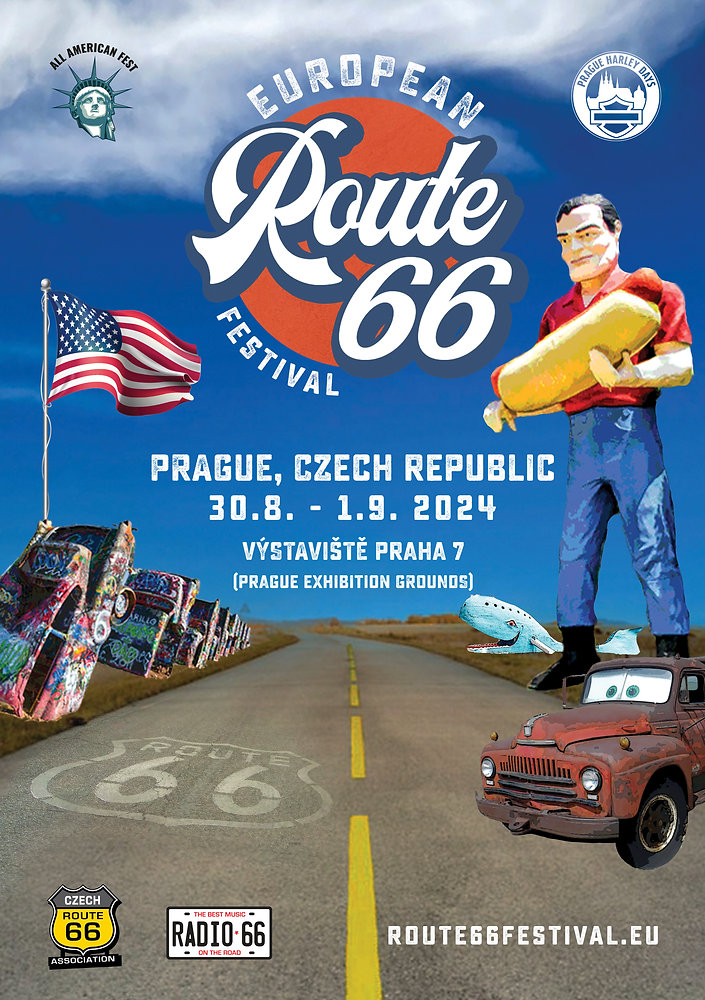
Tens of thousands of Route 66 fans from Italy to England gathered in late August 2024 for the return of the European Route 66 Festival. The event, held every two years, had been on hiatus since 2018 due to pandemic-related disruptions. Now, it was back. Even the President of Czechia was present to officially kick off the three-day celebration of Americana and to shake hands with Oklahoma Lieutenant Governor Matt Pinnell.
The festival’s revival was part of a larger event known as the All American Fest, famous among European roadies for its “Harley Days” celebration of classic American choppers.
“For so many people, especially in Europe, Route 66 represents this microcosm of America,” says Rhys Martin, president of the Oklahoma Route 66 Association. He was part of a delegation that traveled from the U.S. heartland for the Czech festival. He described the festivities, which took over central Prague’s exhibition grounds, as a surreal “bubble” of American nostalgia.
The Roots of the European Route 66 Movement
To understand how Route 66 ended up in central Europe, one must look at the super-fans who brought it there. The festival is organized for those who dream of cruising the iconic American eight-state route and for the small but dedicated group of European Route 66 enthusiasts who can’t wait to experience it again.
Zdeněk Jurásek, president of the Czech Route 66 Association, first traversed the entire Route 66 on a bicycle in 1998. Later, he led tour groups of Czechs and Slovaks down America’s Main Street. But he felt the absence of Route 66’s spirit in his homeland. In 2007, Jurásek teamed up with friends to create the Czech Route 66 Association. Others followed suit. Wolfgang and Anja Werz started Route 66 Germany in 2011, and Dries Dessels founded the Dutch Route 66 Association in 2014.
The German group then organized the first-ever European Route 66 Festival to bring the Americana spirit to the Old World. That first festival took place in 2016 in Ofterdingen, Germany, and attracted Route 66 fans from across the continent, including those from Scotland and the Canary Islands. Representatives from several U.S. states and the historic Boots Motel in Carthage, Missouri, attended the Bavarian gathering. There were poker runs, photo contests, and classic rock bands. Evenings were spent exchanging travel stories in dimly lit taverns.
A Growing Community of Enthusiasts
“The success convinced us to continue,” says Jurásek. Two years later, the festival moved to Zlin, Czechia, where it grew to around 10,000 attendees. By 2024, that number had doubled. Today, the festival draws not only Europeans who have made the Route 66 trek but also motorcyclists and classic-car lovers.
“Route 66 is what brings them together—a theme that remains entirely positive, non-divisive, and genuinely welcoming,” says Jurásek.
Part of Route 66 culture evokes a nostalgic, if romanticized, view of the USA. But upon experiencing the all-American road trip on the ground, the idea of riding a Harley off into a desert sunset develops into a more profound story.
“Route 66 represents freedom, good music, food, history, and an encounter with American traditions and culture—but at the same time, it’s about people and their stories,” wrote Marián Pavel, founder of the app Route 66 Navigation, in an email while on the road in Arizona on his 17th trip down Route 66, despite having grown up in Slovakia.
“Many will start a conversation with you, and you often find yourself relaxing on the patio of a historic Route 66 motel with a beer in hand, talking as if you’d known each other for a hundred years. . . . A journey on Route 66 will break down your prejudices, show you rural America and its people in their true light.”
A Symbol of Freedom and Cultural Exchange
Martin of Oklahoma agrees. “When [travelers] do get here, they get to experience places that tell the story of Native American culture here in Oklahoma, or the African American traveling experience during Route 66’s so-called heyday, which was very different than it was for white Americans,” he explains.
Martin points to the Threatt Filling Station in Luther, Oklahoma, the only known Black-owned and -operated gas station on Route 66, which will reopen in May 2026 as an interpretive center about being a Black traveler during the Jim Crow era.
For Jurásek, Route 66 is much more than neon-clad motels and quirky photo ops. “Speaking as someone from a part of Europe long controlled by communist regimes, Route 66 carried an almost mythical meaning,” says Jurásek. “We weren’t allowed to travel west, so for many of us, the Mother Road symbolized, first of all, freedom and a different way of life.”
Passing through state after state, with borders marked only by welcome signs, has long been an American privilege, predating the European Union’s open-border concept by a couple of hundred years.
Pavel, who grew up in the former Czechoslovakia in the 1980s, remembers borders fenced off by barbed wire. “For me, Route 66 represents the kind of freedom many people, accustomed to its benefits, take for granted—the ability to simply pack up, get on a motorcycle, and ride across a vast country . . . just because I can.”
Looking Ahead to the Future
The next edition of the European Route 66 Festival would have taken place this year, but the organizers are planning to skip it this time around. After all, 2026 is also the 100-year anniversary of Route 66 in the U.S. Since Jurásek—and undoubtedly many others—will be celebrating out on the open road, festivalgoers will have to wait for the next iteration in 2028.
For now, if you’re on a road trip between Chicago and Los Angeles or planning to participate in any centennial events, look for more Europeans on the Mother Road. “In the centennial year, I’ll be spending a significant amount of time in the United States,” says Jurásek. “Together with our fans, we’ve planned three full crossings of the route—something I’m truly excited about.”