By Chris Bucholtz
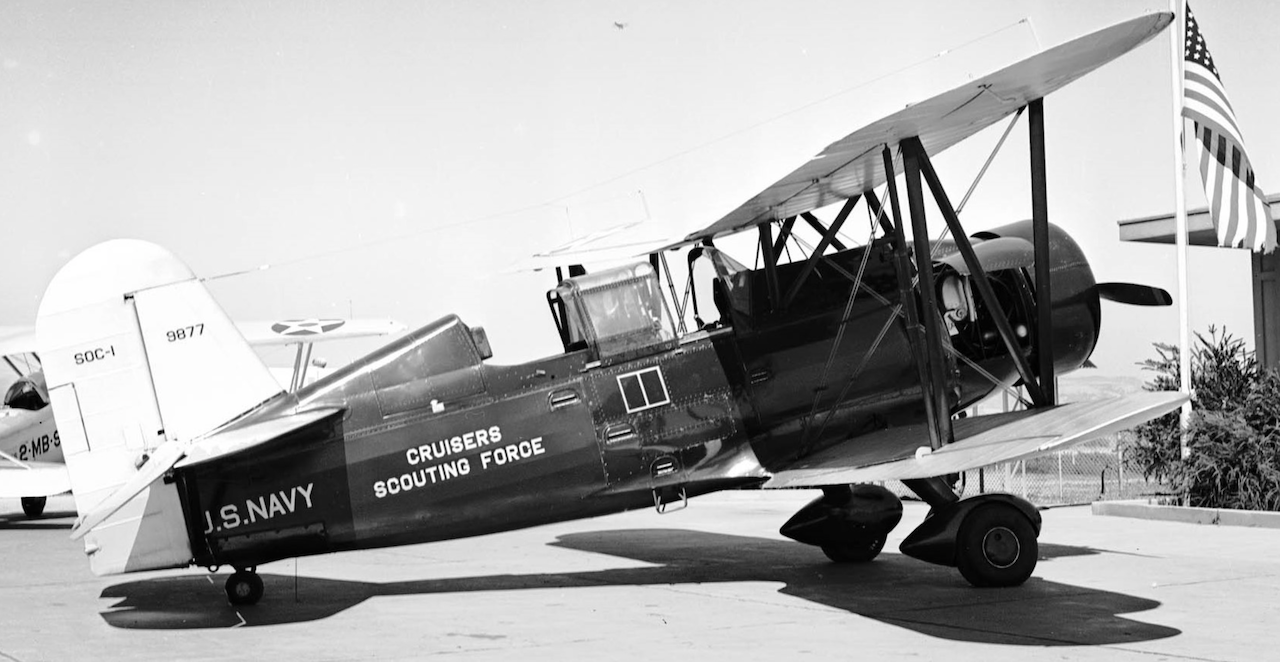
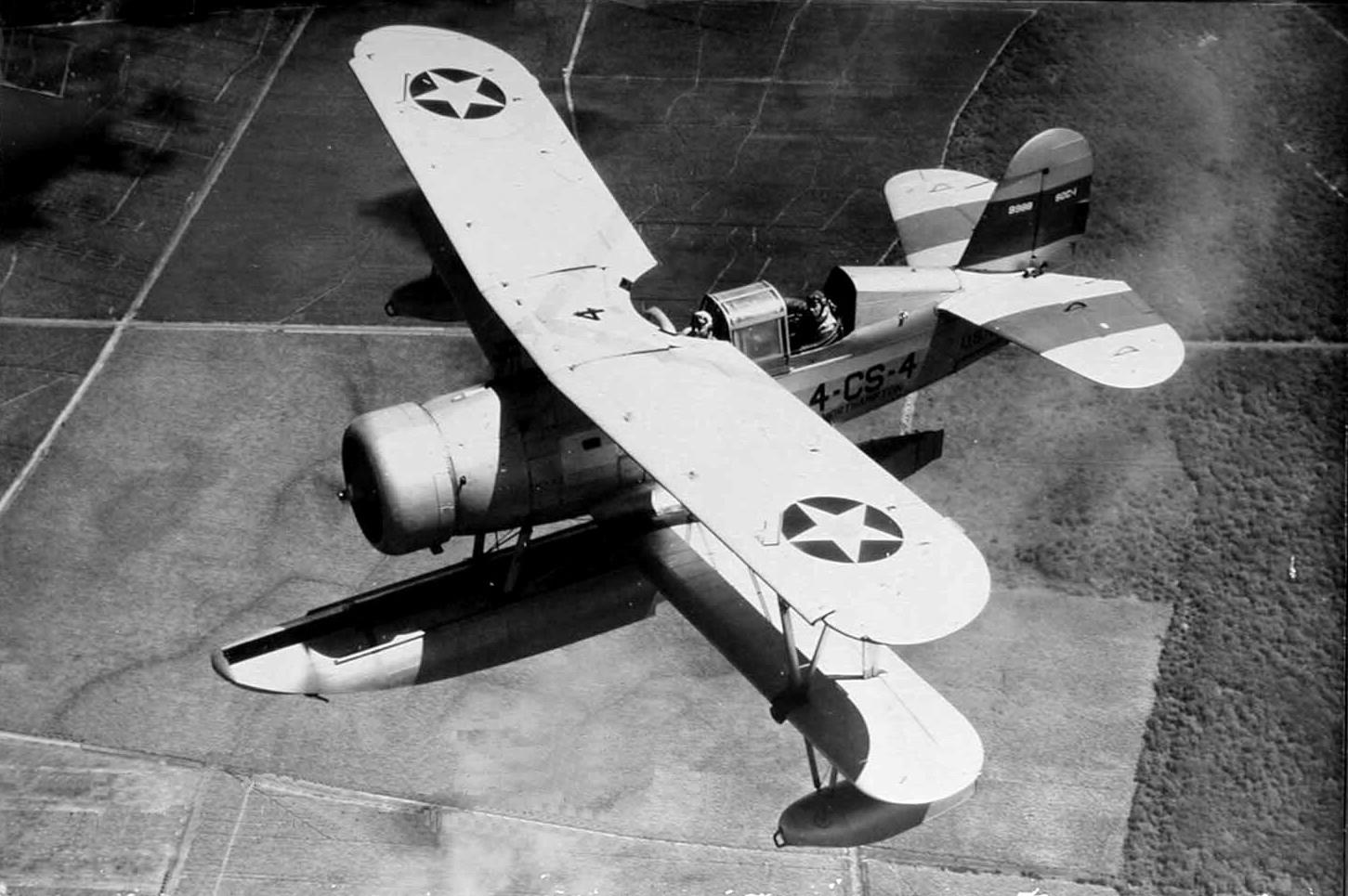
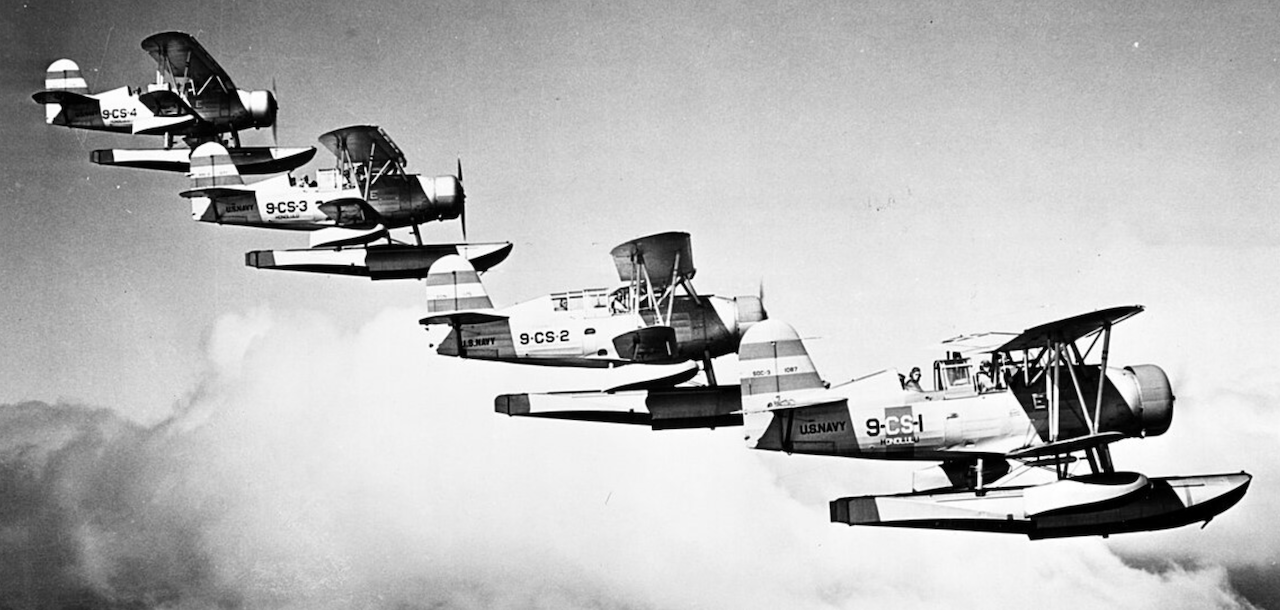
The message shocked the crew of the USS Northampton: Pearl Harbor had been attacked. The cruiser would inflict some measure of revenge against the Japanese on December 7, 1941 – not with its battery of eight-inch guns, but with a pair of planes that looked like they were from another era: Curtiss SOC Seagulls. The Seagull was the only biplane the U.S. Navy used in combat in World War II. A boxy, single-bay biplane, powered by a 600-horsepower Pratt & Whitney R-1840 turning a two-blade propeller, it sported a single large float below the fuselage, with stabilizing floats fixed under the wingtips, and it was armed with two .30-caliber machine guns, one firing through the propeller arc and the other on a flexible mount for the radioman. Admiral William Halsey ordered launch a search for the Japanese fleet, and at 1115 hours, some 200 miles from Pearl Harbor, Northampton contributed to the effort by catapulting aloft two Seagulls, one crewed by LT Malcolm C. Reeves and Radioman First Class Robert P. Baxter, and the other by ENS Fred Covington and Radioman Second Class James R. Melton. They were ordered to conduct a sector search 150 miles north of the task force. Little did the two crews realize that they would score the last American victory of the Day of Infamy.
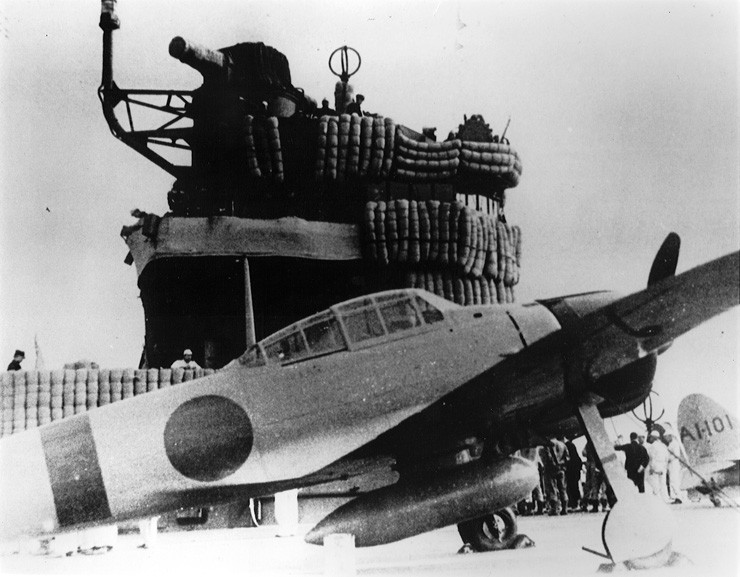
“We were in close formation at about 1000 feet an hour after launch when I spotted an aircraft approaching from astern at our altitude,” reported Baxter. “The dihedral of the wings made me think it was one of our own SBDs.” Instead, the interloper was an A6M2b Zero, which opened fire as it raced past the SOCs. Baxter said he saw a red band around the fuselage of the Zero, which would indicate a fighter off the carrier Akagi. As the Zero turned to make another run, Reeves and Covington dived to wave-top level to deny the Zero a shot at their bellies. In response, the Japanese pilot initiated a series of high overhead attacks, and the SOCs ducked and dodged while their gunners fired back at the diving Zero with their .30-caliber guns. The frustrated Zero pilot was forced to cut his speed and drop his flaps to give himself time to fire at the SOCs, which had a leisurely top speed of 165mph.
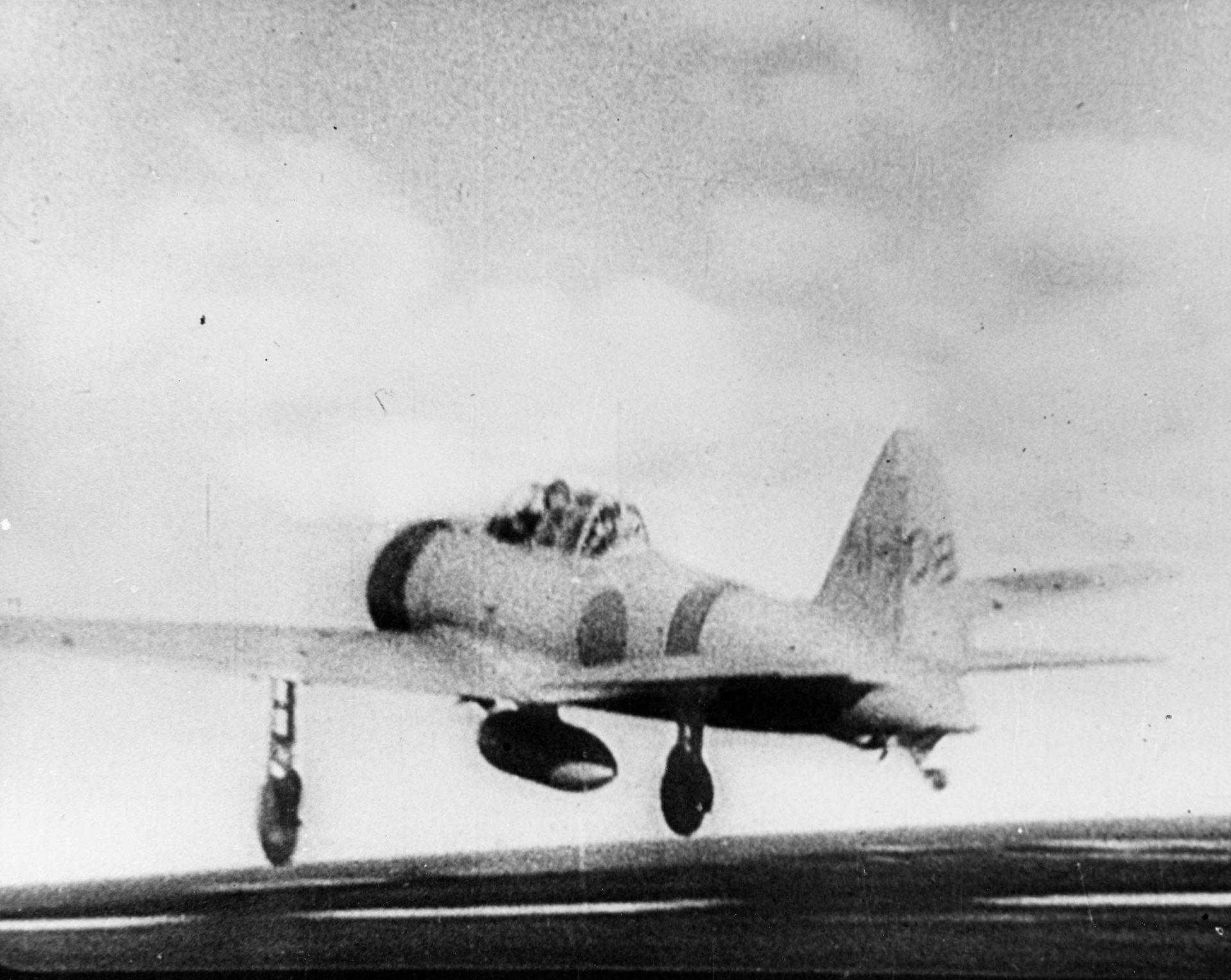
When the Zero pulled out of his diving attacks, Baxter noted that he tended to “mush” on the pull-ups, reducing the gunners’ deflection angle. Rounds from the Zero hit the SOCs – Reeves and Baxter’s plane was hit 14 times, and Covington and Melton were hit by 11 rounds, once through Melton’s cockpit – but on the Zero’s fourth, fifth, and sixth passes, Baxter said he thought he saw hits on the Zero. “On the last run, our wingman ran out of ammo,” said Baxter. “But on the Zero’s pull up, I had a good bead on his nose, and I pulled the trigger as he passed right through my line of fire. The bullets impacted the Zero, and it caught fire and began to stream black smoke.” The Zero broke off its attack and headed toward Ni’ihau, 15 miles away, which had been briefed as a pick-up point for downed Japanese fliers. “I tracked his black smoke until it terminated near Ni’ihau,” Baxter said. Did the Japanese plane go down? Akagi lost one Zero in the attack over the harbor; the identity of the SOCs’ attacker is lost to history. In any event, the improbably heroic SOCs had delivered a morale-raising defense that few could have expected.
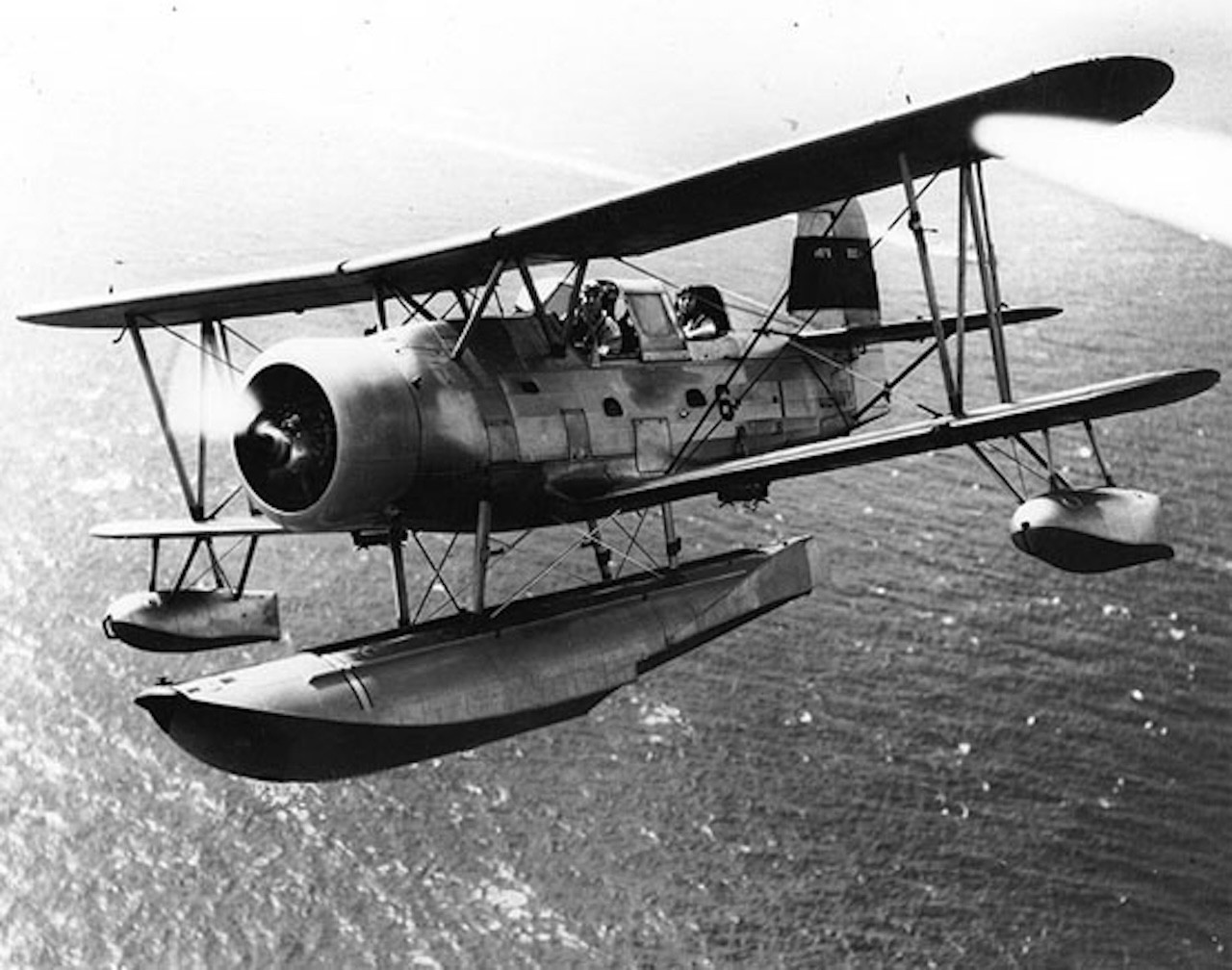
By the time of the attack on Pearl Harbor, the SOC had been flying from American cruisers and battleships for six years. Ordered in 1933, the first aircraft reached the fleet in 1935, going to sea on the cruiser USS Marblehead. The Seagull may have looked antiquated, but it was just what the Navy needed. Its Vought O2U and O3U Corsair catapult scouts were worn out, having entered service in 1929. The SOC was a more robust aircraft, and although its performance was slightly inferior to the Vought planes (at 165mph, it was two miles an hour slower, its 675-mile range was five miles less, and its 14,600-foot ceiling was 4,000 feet lower), its engine had double the horsepower, and it was a safer aircraft. The aircraft started life in 1933 as the XO3C-1. The prototype had an open cockpit and was intended as an amphibious aircraft with wheels that retracted into the central float. A redesign removed the landing gear and enclosed the cockpits, something that would be appreciated by naval aviators operating the type in Aleutian and North Atlantic waters some years later. The plane had full-span Handley-Page leading-edge slats, which automatically deployed at slow speeds to assist handling. To increase its versatility, the SOC could be fitted with fixed landing gear for land operation. The wings folded, reducing the width to 12 feet, allowing a battleship to carry as many as eight aircraft.
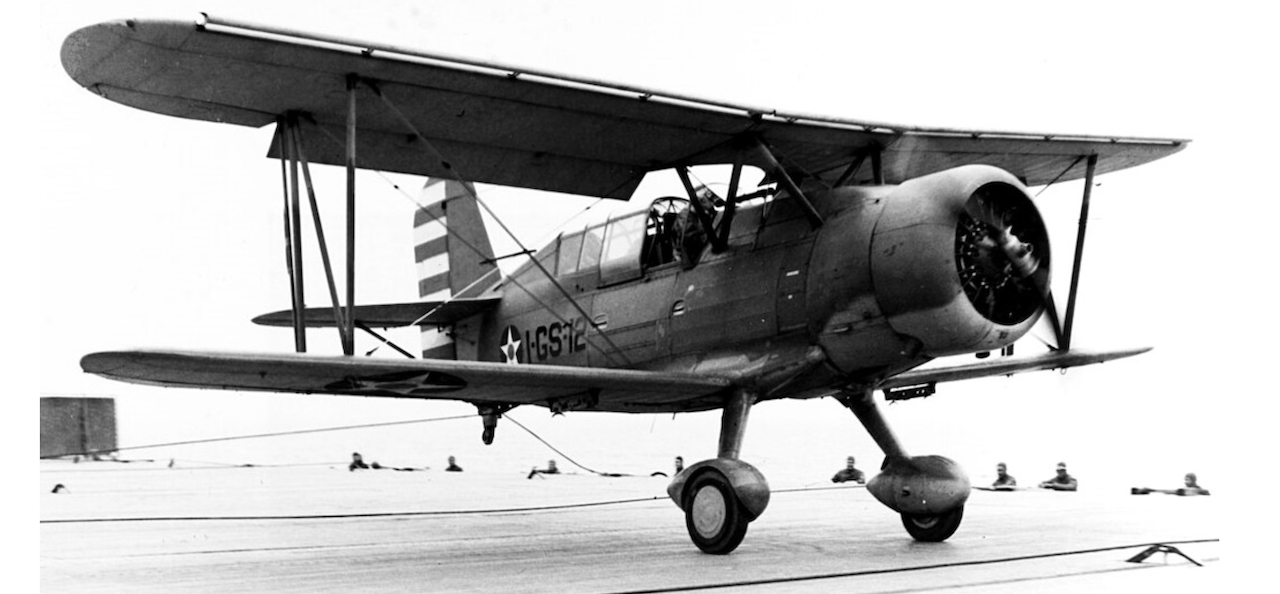
Production spanned 1935 to 1938, with an eventual 263 SOCs and 44 SONs (identical aircraft built by the Naval Aircraft Factory) being furnished to the fleet. They quickly supplanted the older Vought aircraft on battleships and cruisers, and even the destroyer Noa, a test installation that led to an order for six new destroyers to be outfitted with a catapult and crane (which was eventually cancelled). The versatile Seagull was the fleet’s jack-of-all-trades. In 1940, the plane earned notoriety when a critically-ill seaman was flown from a ship at sea to the Naval Hospital in Philadelphia. Later, 15 of them became “flag planes,” or the personal aircraft of high-ranking admirals, and starting in 1940, detachments of tailhook-equipped wheeled SOC-3s were used aboard six escort carriers until replaced by newer types. By 1941, the Vought OS2U Kingfisher had displaced the SOC from battleships (where folding wings were not required), but the Seagull still served aboard the Navy’s cruisers.
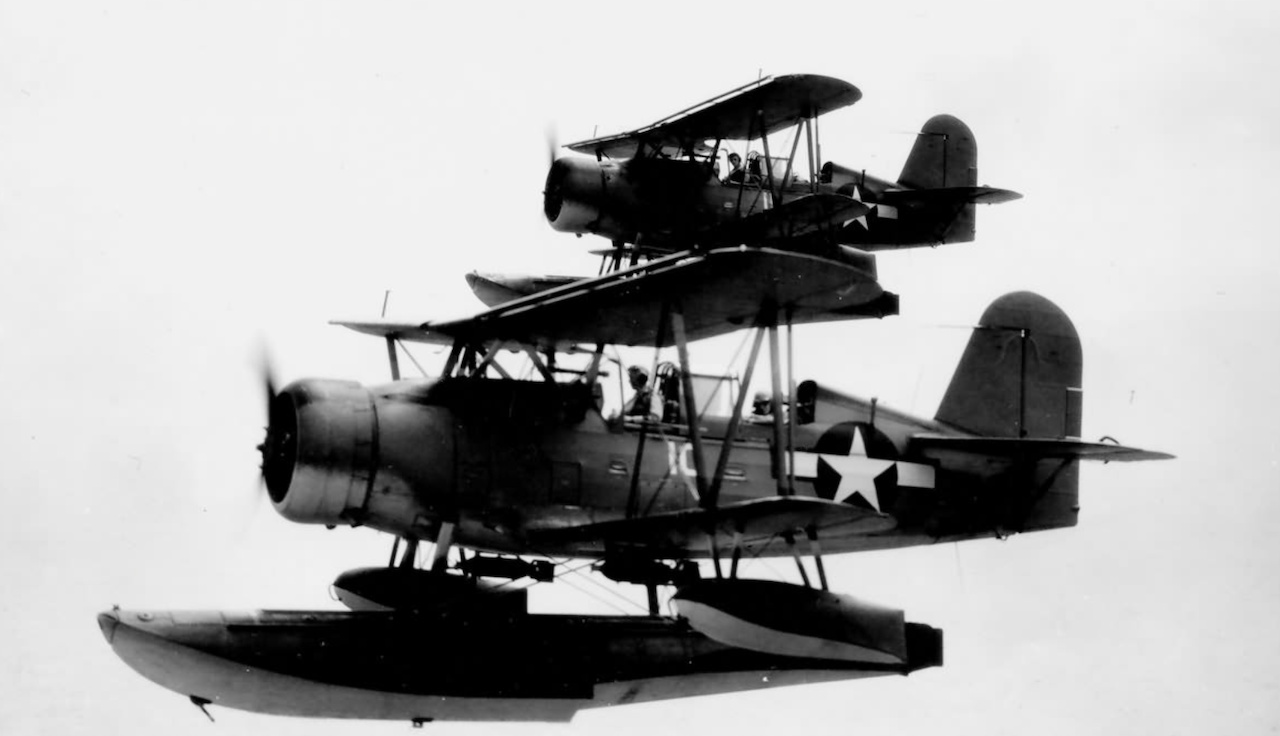
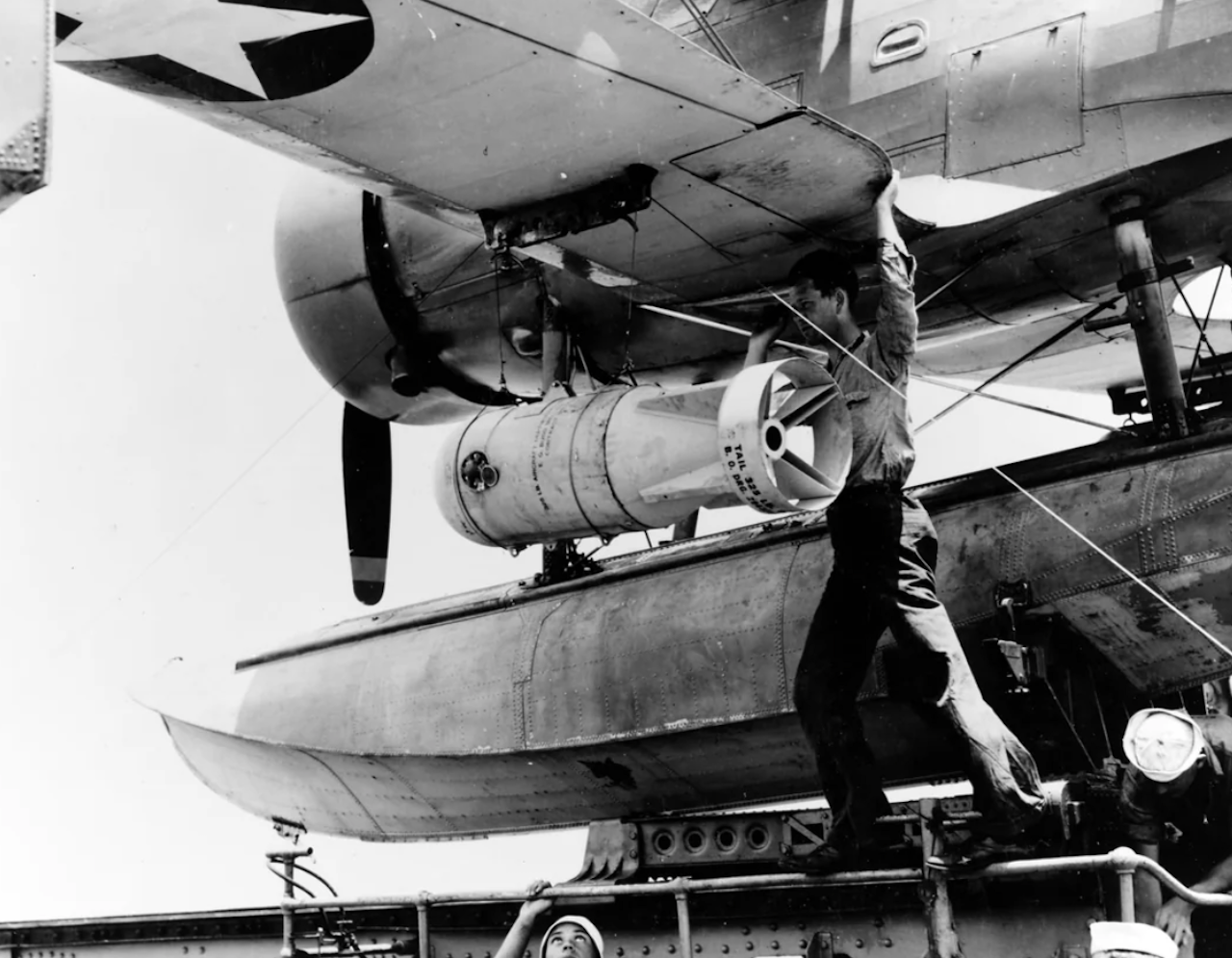
Pilots liked the docile SOC, but it was no hot rod. They joked that the SOC was a consistent aircraft: you took off at 70 knots, performed high-speed maneuvers at 70 knots, and landed at 70 knots. But that was fine for its expected duties as the eyes of naval artillery, spotting the fall of shot for cruisers and battleships. When WWII began – and the battleship was no longer the fleet’s main weapon – the SOC adapted to take on the necessary but unglamorous task of inner patrol. Seagulls hunted for submarines, sometimes carrying up to 500 pounds of depth charges. They flew search-and-rescue missions for downed airmen, and they were charged with message-drop flights when radio silence was required. SOCs were airborne for virtually every daylight engagement involving American cruisers in 1942-43, and they also scouted for PT boat squadrons during fighting in there Solomons. Another task that fell to the SOCs was towing targets for ships’ anti-aircraft practice. The SOC carried a 20-foot canvas sleeve with metal rings at each end, the front one larger than the rear one, so it would open up in flight. The sleeve was folded into a container attached to the seaplane’s bomb rack, and when the sleeve was extended on a 100-foot line. Ship’s machine gunners would fire with bullets tipped with different colored paint; after the firing concluded, the sleeve would be dropped and recovered by a boat, where the colors would allow the gunners to be evaluated. “Distance from the target was the only safety measure for the seaplane crew!” remembered CDR Ralph “Kaiser” Wilhelm, who flew the SOC-3 from USS Portland as an ensign from 1940 until Portland was badly damaged at the First Naval Battle of Guadalcanal on Nov. 13, 1942.
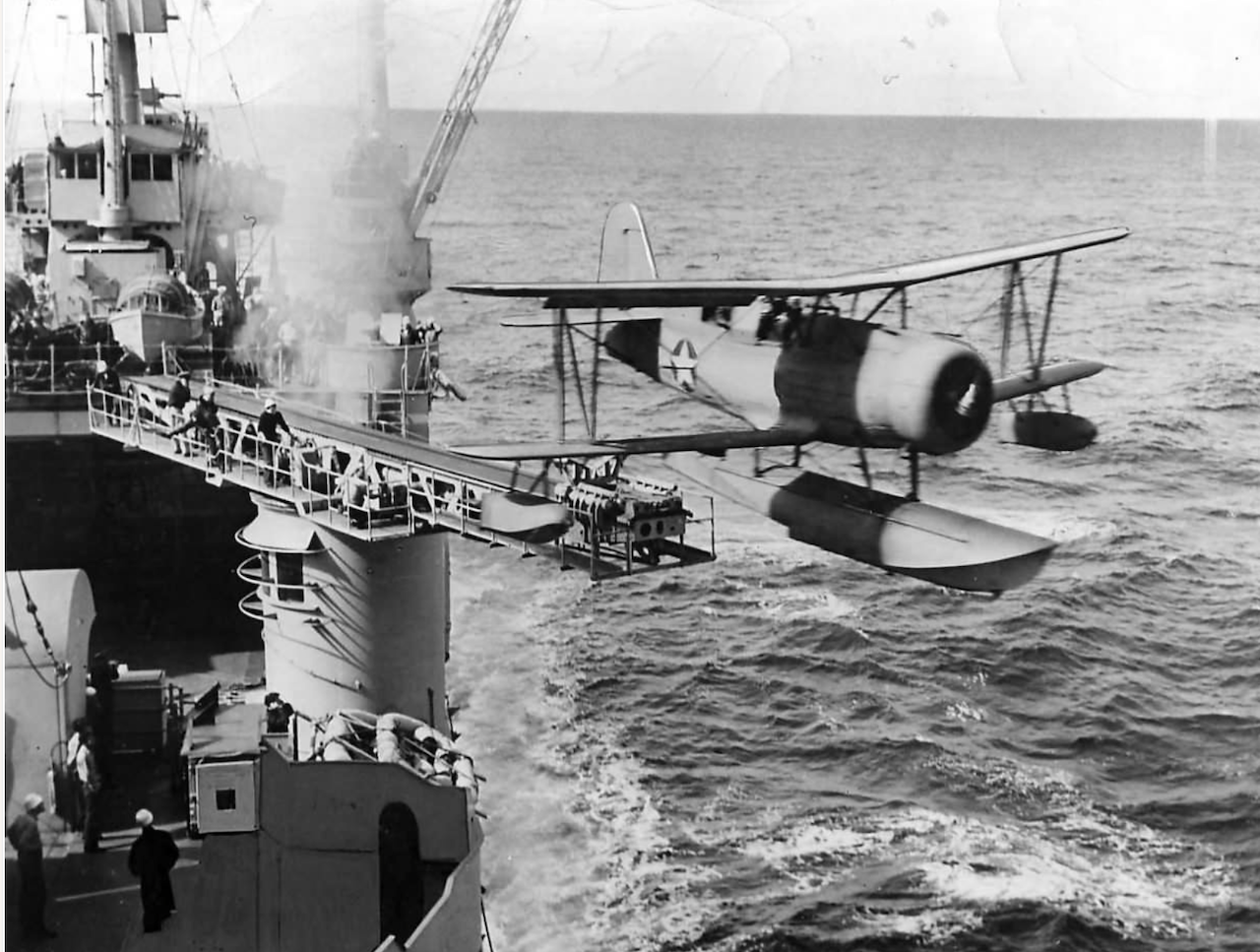
While few missions involved air-to-air combat, every flight from a cruiser was exciting. To launch an SOC, the ship would sail into the wind, much as an aircraft carrier would do, to increase the relative airspeed. The crew would board the plane atop the 30-foot catapult track, on which the SOC perched with its float resting on a small trolley. The pilot would run up the engine and then switch off the magnetos, watching the fall-off in RPMs for each. If the fall-off was greater than 60 RPM, it mean the ignition wires were damp and the plane would need to warm up for a few more minutes. If the ignition wires were ready, the pilot would give the ready signal to the catapult officer, often one of the ship’s complement of pilots. Timing his order to the roll of the ship, the catapult officer pulled a lanyard that fired a powder charge in the trolley that was the same as that used on a five-inch shell. With a loud bang and a burst of smoke, the trolley hurtled forward and clanked into the end of the catapult rail, flinging the airplane into the air. The SOC-3, now traveling at 80mph, wobbled as the pilot regained control, then accelerated and climbed away.
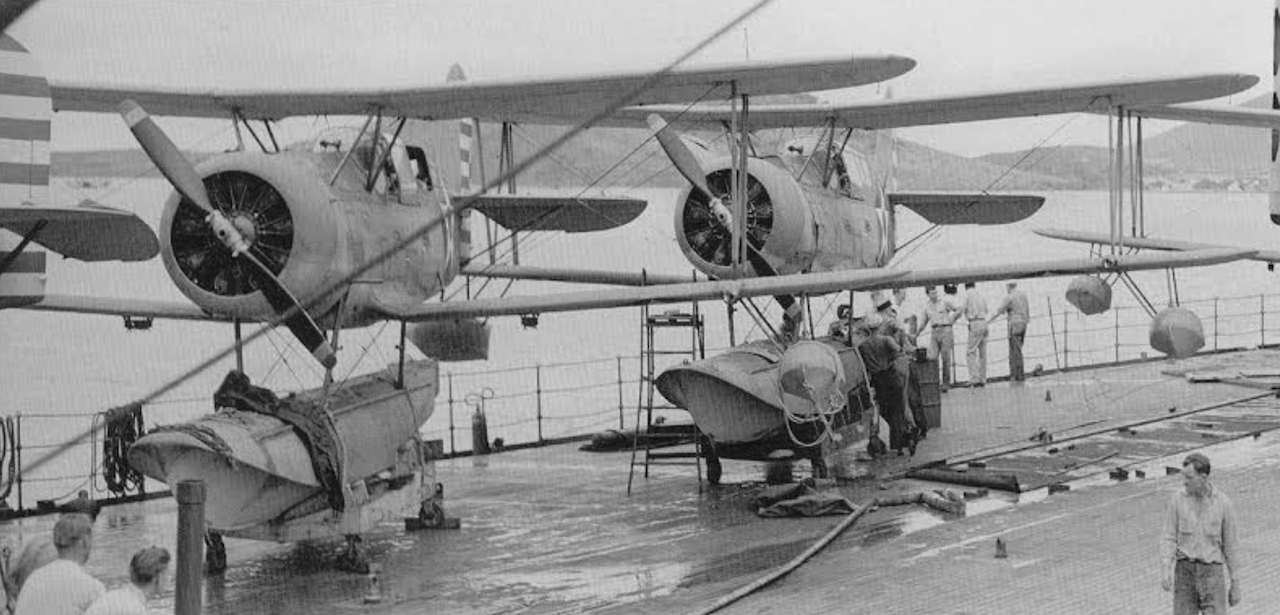
“A pilot not properly braced for the shot could come off the cat with the throttle closed by the force of acceleration and plunge into the sea, or the pilot could find the joystick had been pulled back too far by the force of acceleration, and the plane would flutter into the sea after stalling on too steep a climb,” said Wilhelm. If the launch of an SOC was sudden, its recovery was a bit less so. The cruiser would steam at least 12 knots at an angle of 30 to 60 degrees to the wind. With the raising of the “Cast” flag, the cruiser would start a turn through the wind line with the intention of creating a relatively smooth “slick” for the SOC to land in. “The pilot would synchronize his final approach with this maneuver, making a wide left turn, gradually letting down with full flaps, and setting his plane down in the slick as close as possible to the ship,” said Wilhelm. The ship would tow a “sled,” which resembled a cargo net; The pilot would taxi the plane forward until a hook on the underside of the main float snagged the webbing of the sled and the cruiser began to tow the aircraft.
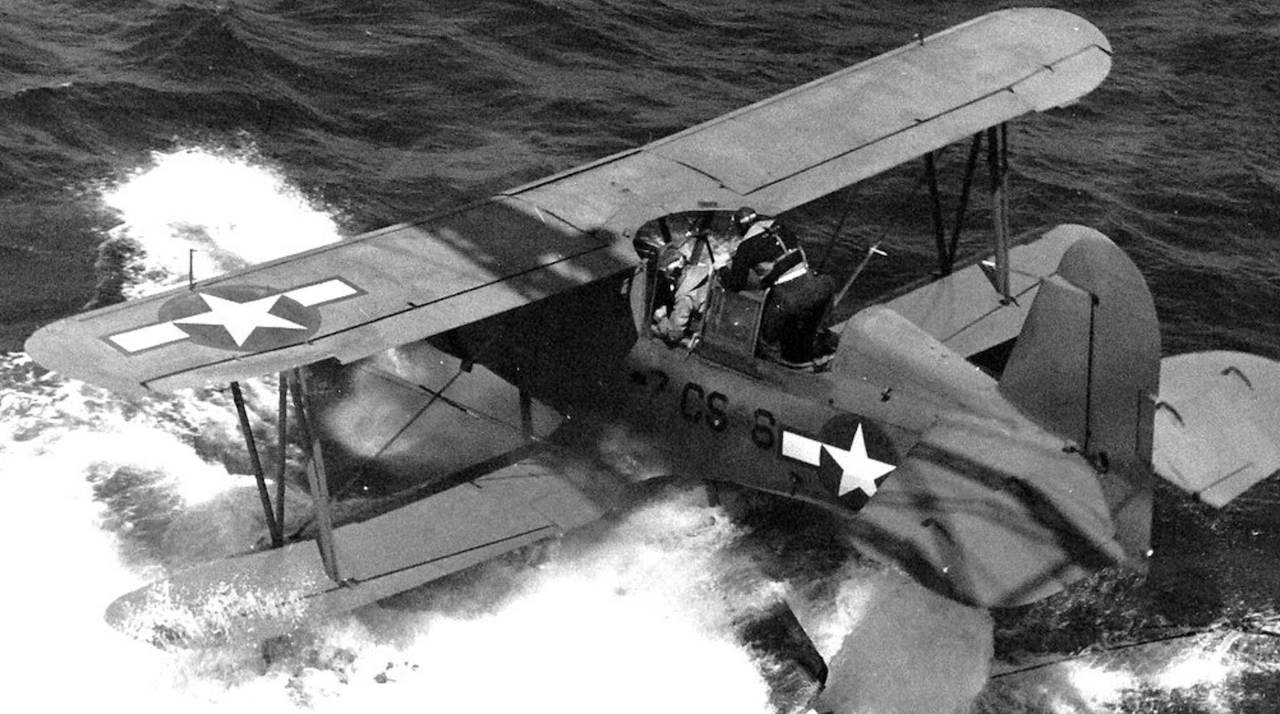
“The pilot would turn off the ignition and stop the engine as the crane operator on the ship lowered a hook,” Wilhelm said. “At this point, the radioman/gunner would climb forward from the after cockpit and stand upright over the pilot in order to grasp the crane’s hook. The pilot would hold onto the radioman/gunner’s ankles to prevent him from falling off the aircraft, which by now would be swaying back and forth in the wind.” After the radioman/gunner slipped a steel loop from the upper wing of the aircraft over a hook lowered by the ship’s aircraft handling crane, the seaplane was hoisted aboard and returned to the catapult. Both port and starboard-side recoveries used a similar approach, but the starboard recovery was more difficult, Wilhelm said. “As the throttle was advanced for taxiing up the starboard side of the ship, the torque of the plane’s propeller would continue to pull the nose of the plane to the left and into the side of the ship. This could be countered, to some extent, by a small water rudder on the rear of the plane’s main float, but it was usually not adequate to overcome the torque of the propeller.” The result could be damaged left wings and wingtip floats.
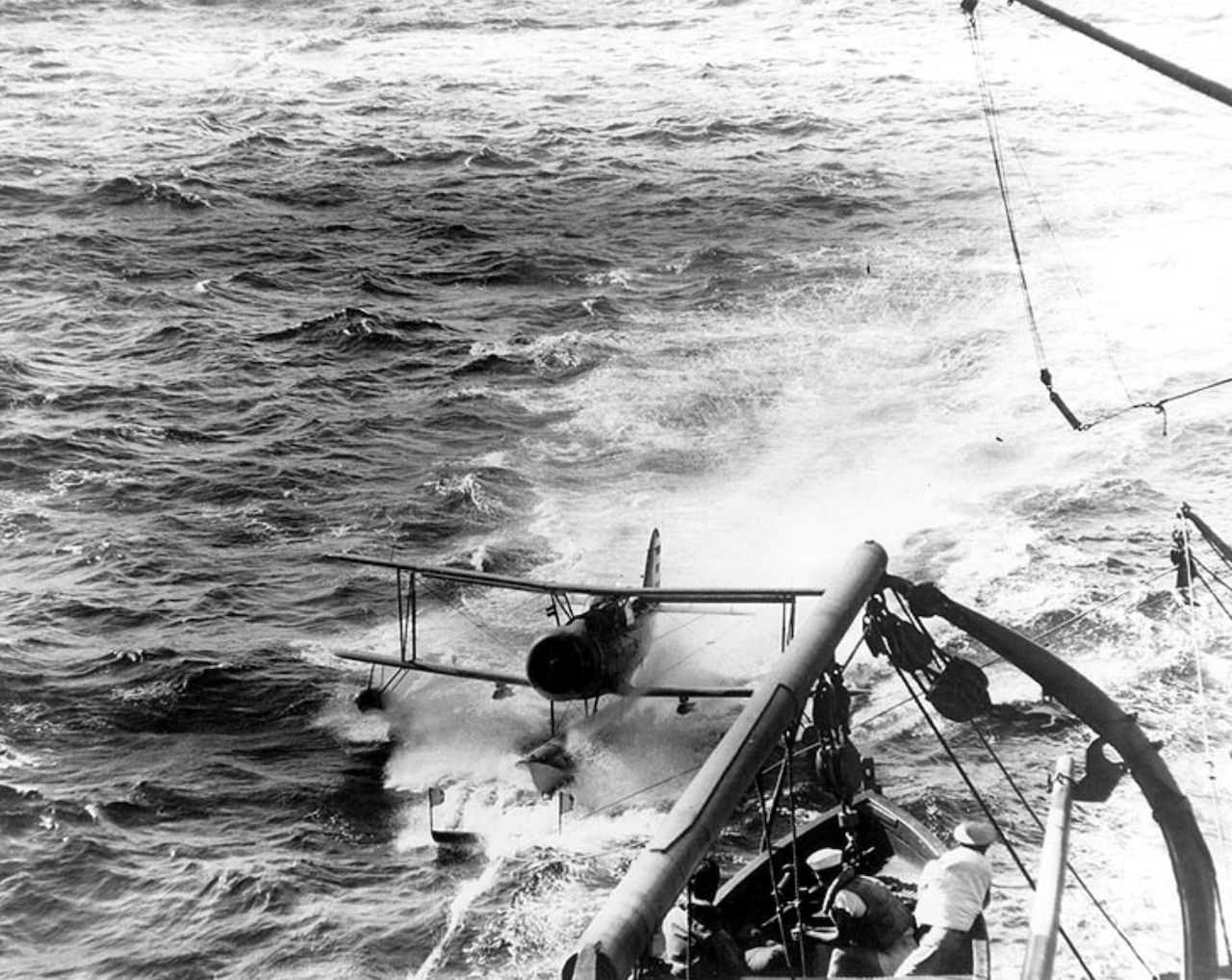
“On a plane being tossed about by wind and seas, especially in choppy weather, recovery could be a very touchy operation!” said Wilhelm. “The entire procedure was not unlike a ballet, requiring precise, synchronized actions by many people throughout the ship, many without visual contact, and with the potential for disastrous results if mistakes were made.” On July 9, 1942, Wilhelm experienced a taste of this. Landing in choppy seas, a large cross swell knocked off his SOC’s right wingtip float. “The sea was very rough, and although my radioman, Fred Dyer, who weighed over 200 pounds, immediately went out on the port wing to hold the right wing from dipping in the water, the seaplane soon turned over. Dyer and I were left sitting on the bottom of the main float, with the plane upside down below us. Portland sent a message by blinker that they would return for us within an hour!” The landing operation made the cruiser vulnerable to enemy attack, so it wasn’t always possible to stop and recover a downed crew right away. “Later, the ship returned and sent a motor whaleboat to pick us up,” said Wilhelm. He had a new Bulova watch, which he put in his mouth to keep safe for the short swim to the boat. “The ship attempted to salvage the seaplane, but without success. So the boatswain sank SOC-2 #0406 by chopping holes in the main float.”
Exposure to attack during recovery operations wasn’t the only trade-off cruisers made in order to operate the float planes. If the cruiser had to engage in a gun duel with an enemy ship, the SOCs represented a fire hazard in the event of an enemy hit. Before the Battle of Midway, Wilhelm said, the cruiser pilots were warned that in the event of a surface action, the ship’s four SOCs would be launched and would have to “attempt to reach Pearl Harbor, 1200 miles away. This would require refueling at French Frigate Shoals along the way.” Fortunately, no such engagement took place, but as a contingency Wilhelm loaded his SOC with “my spare laundry bag, with four canteens of water, five emergency rations and a flashlight!”
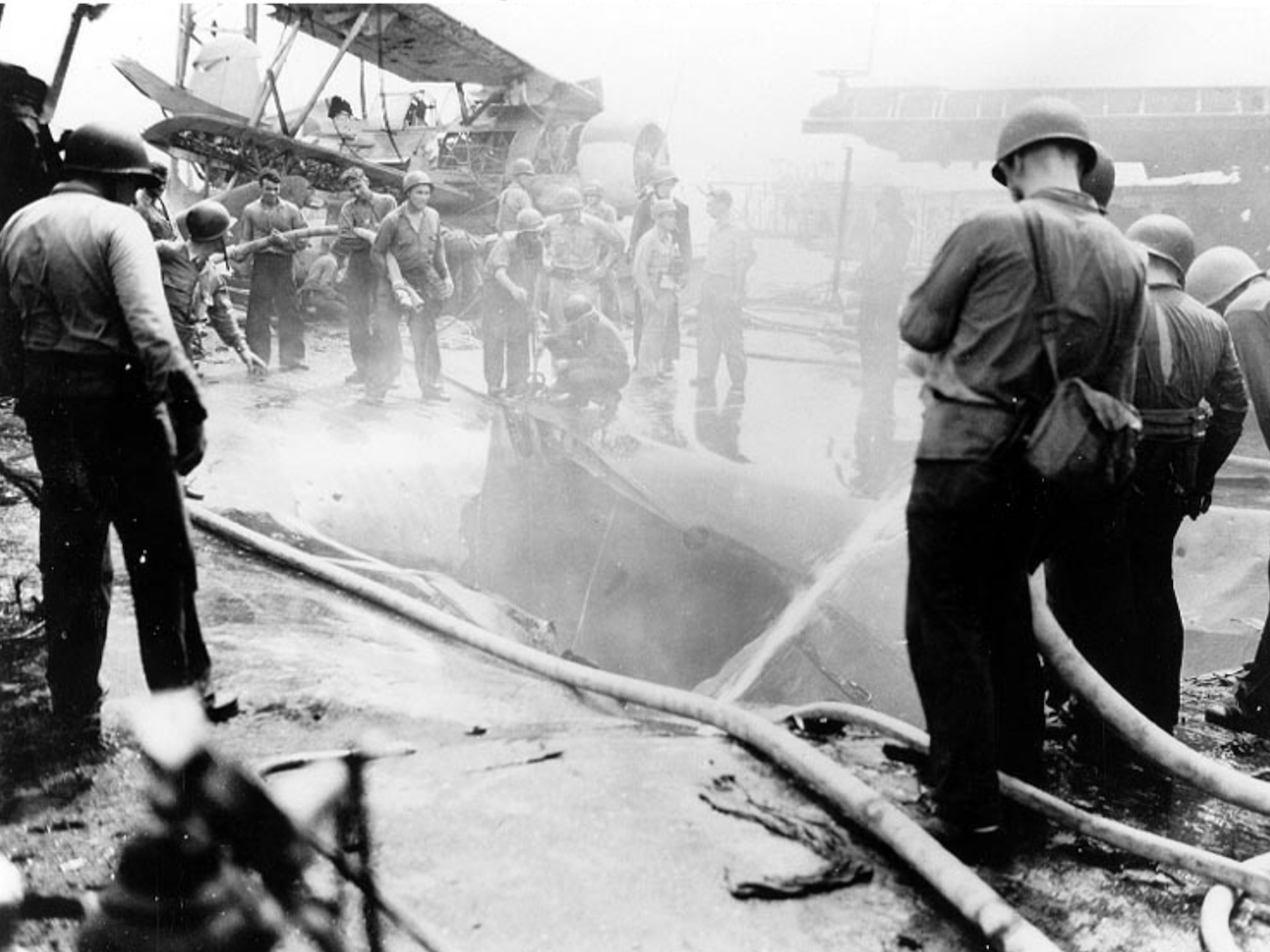
The SOCs performed effective service throughout 1942 and 1943, but by 1943, the SOC design was already 10 years old. Curtiss and the Navy had a replacement waiting in the wings: the SO3C-1, which was also, confusingly, given the name Seagull by the Navy. This was a peculiarly-proportioned monoplane that used the notoriously unreliable and underpowered Ranger V-770 inverted-V engine. The aircraft also suffered from severe stability problems, resulting in fixes like upturned wingtips and a dramatically enlarged vertical tail.
The SO3C-1 (which was known as the Sea Mew in British use) started to replace the SOC in 1942, with the first planes to go to sea aboard USS Cleveland in July 1942. Gradually, the SOCs were withdrawn from service and sent to training units. But with the fleet, experience with the SO3C-1 ruined its reputation. The Ranger engine tended to overheat at low speeds, and the tall tail made recovery operations very challenging in windy conditions. Squirrelly flight characteristics and a poor maintenance record doomed the SO3C-1; even as Curtiss raced to deliver the improved SO3C-3, the type was withdrawn from U.S. Navy shipboard units starting in late 1943. Its replacement in the fleet? The SOC, which was taken from the stateside training units and returned to the cruiser force, where it served until the end of World War II.
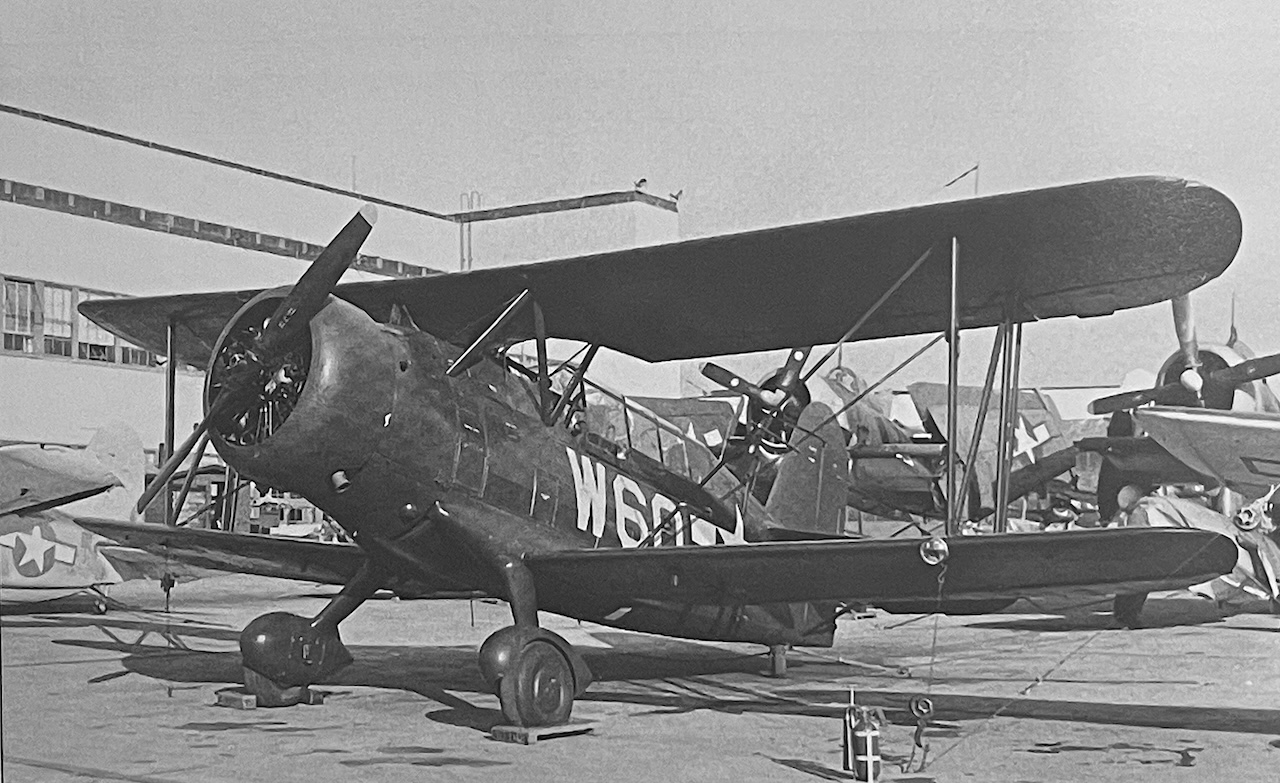
Starting in July, 1945, Curtiss finally delivered an adequate replacement for the venerable SOC: the SC-1 Seahawk, a single-seat monoplane scout that was nearly 80mph faster. The SOCs once again were sent to training units and used in second-line roles. One of the biplanes was grabbed as the personal aircraft of the commander of Scout Observation Service Unit 3 at Naval Air Station Alameda, and re-painted in the current overall glossy sea blue paint scheme. But the floatplane’s days were numbered; the advent of the helicopter meant that even the new SC-1 no longer had a place in the fleet. Despite a 10-year career that spanned a period of remarkable advances in aviation, the surviving SOCs vanished rapidly, and sadly, no intact SOCs exist today.