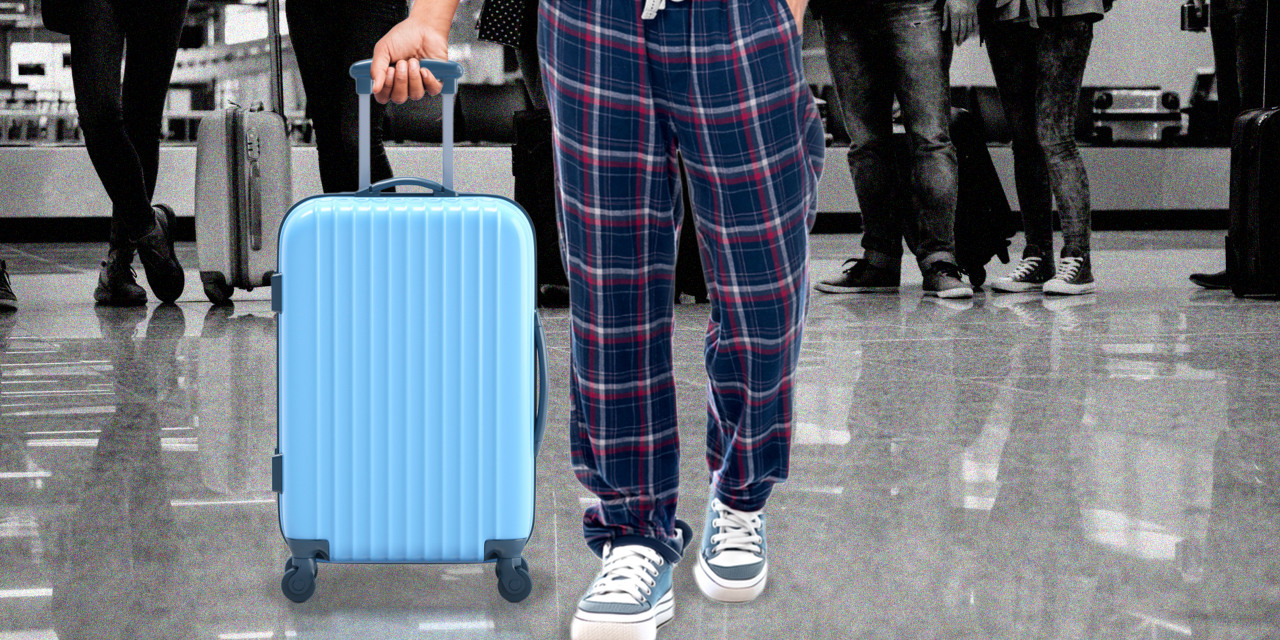
Nowadays, it’s common to observe individuals wearing pajamas outside their house — fora stroll in the park or even when dining at a fancy restaurant. The phenomenon of wearing sleepwear as regular attire is currently very popular, as noted by fashion specialists.
But if you’re thinking about joining the pajama gathering, should you reconsider if your travel itinerary includes a visit to Tampa, Florida?
A post on X that became widely shared — receiving 7.1 million views by Thursday afternoon — saw Tampa International Airport declare, “It’s time to ban pajamas.” The message continued by stating, “The chaos ends today,” and also mentioned a previous restriction on Crocs at the airport.
To be clear, the airport’s “bans” are actually meant to be humorous. However, officials stated that they aim to highlight concerns about what qualifies as suitable travel attire.
Tampa International Airport frequently posts fun and humorous social media content as part of our continuous effort to connect with our followers,” the airport stated in a message to MathHotels.com. “Today’s post about ‘banning’ pajamas was another light-hearted reference to the ongoing discussions about what to wear on travel days. We advise our travelers to be comfortable and thank our dedicated followers for enjoying the online jokes.
Certainly, if generating discussion was the intention, the post accomplished that. Even though some who responded to the post may not have fully recognized that the “ban” was meant as a joke, they referenced the time when individuals dressed formally for flying, as if it were a significant event.
“Let’s return to how things were in the 1950s, 1960s, and 1970s!” saidone commenter.
Some people believe it’s not worthwhile to dress up, particularly considering the challenges frequently linked with flying these days.
“I’ll wear something nice again when we aren’t treated like livestock at the airport and on the flight,” he said.another commenter.
Let’s not overlook how the matter came to attention, when U.S. Transportation Secretary Sean Duffy promotedvisitors to enhance their clothing collection.
“Let’s avoid wearing slippers and pajamas when we arrive at the airport,” Duffy mentioned at Newark Liberty International Airport in November.
No matter what people think about wearing pajamas as regular clothing, even at the airport, this trend is clearly present. Global pajama sales are expected to reach almost $12.5 billion this year and are anticipated to increase to approximately $21.5 billion by 2035, according toone research report.
Experts claim the trend has sped up due to the move toward remote work in recent years — essentially, why bother dressing up if you’re not leaving your home? Meanwhile, individuals are adopting the concept of being extremely casual outside their homes, which translates to wearing pajamas at the airport or almost anywhere else.
Fashion brands have jumped on the trend, providing loungewear designs that are suitable for multiple environments. Celebrities have been quick to follow along: ThinkMargot Robbie wearing pink pajamas at a movie screening.
You can’t ruin the travel experience over many years and then criticize people for dressing appropriately to handle it.— Etiquette specialist Nick Leighton
So, are you able to put on those pajamas as you prepare for your upcoming flight?
Etiquette expert Nick Leighton mentions that answering this question is challenging for several reasons. He highlights the previously mentioned problem of air travel growing more stressful and uncomfortable—therefore, people are increasingly opting for a more relaxed approach.
“You can’t ruin the travel experience over many years and then criticize people for dressing appropriately to handle it,” he stated.
Additionally, as sleepwear designs grow more stylish, it’s challenging to view them as solely for the disheveled. “What exactly qualifies as pajamas?” Leighton remarked.
Patrick Arnzen, a former airline pilot who currently serves as the chief executive of Thrust Flight, a flight training institution, suggests that feeling at ease during a flight can be beneficial for one’s health. He highlights the importance of maintaining proper blood flow and preventing deep vein thrombosis (commonly known as a blood clot), which is a constant concern when traveling by air.
“That’s why I suggest using breathable materials, compression socks if you tend to experience swelling, and wearing layers at all times,” he stated.
At the same time, Arnzen highlights the danger of being overly relaxed. For instance, he mentions that you wouldn’t want to be wearing flip-flops or sandals if an emergency arises.
Dress in attire that “won’t hinder your escape if you ever have to leave in a hurry,” Arnzen mentioned.