
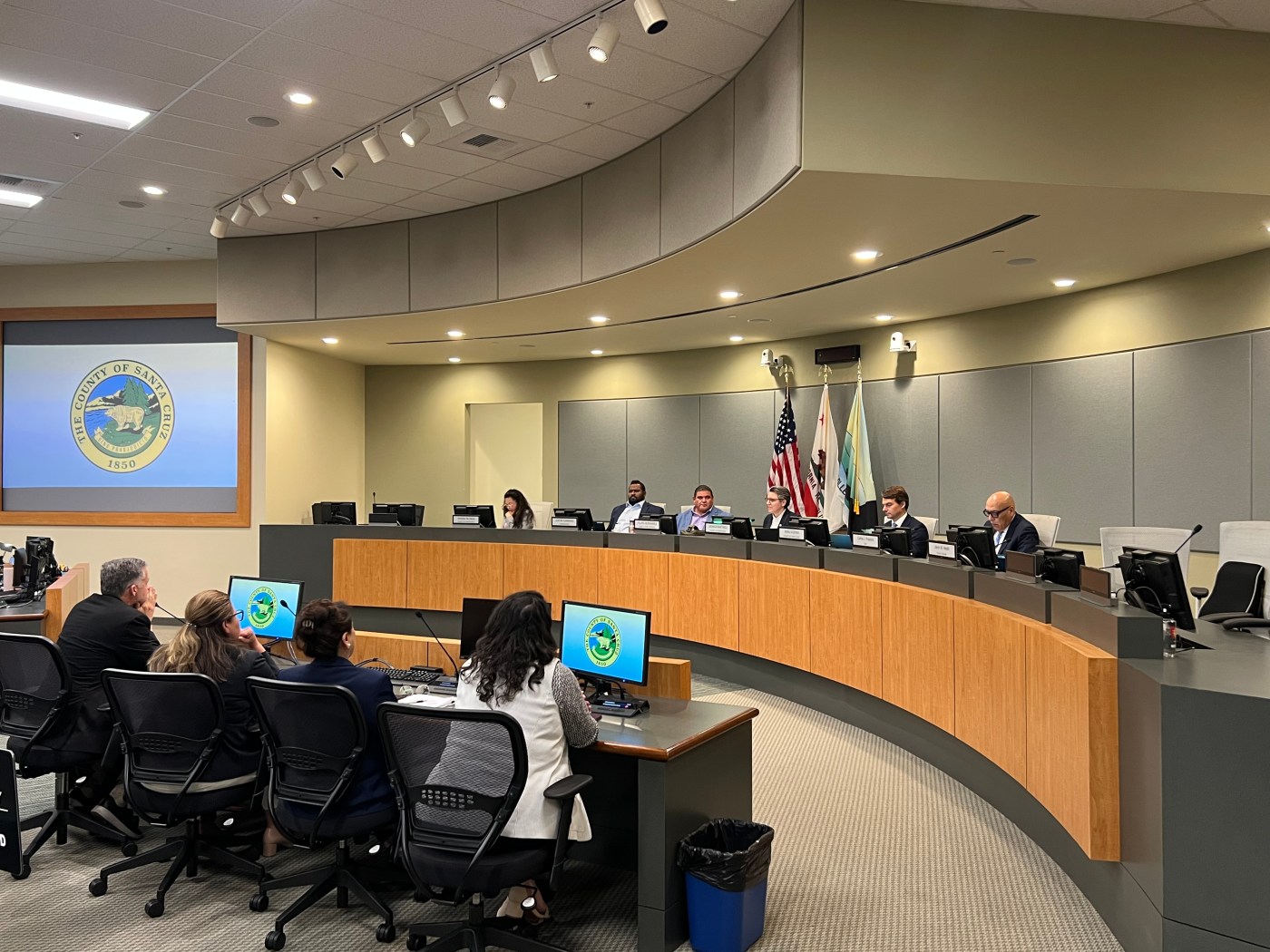
SANTA CRUZ — Officials in Santa Cruz County anticipate a structural shortfall that will increase substantially during the upcoming fiscal year, regardless of whether the county can address the large financial gap caused by reductions at the federal and state levels.
The county is projected to conclude the current fiscal year on June 30 with a $5.4 million budget shortfall, which officials anticipate could grow to $23.2 million in the 2026-27 fiscal year if no significant measures are taken, according to administrative leaders who shared this information at a meeting.mid-year budget presentation on Tuesday.
Furthermore, if the financial effects of H.R. 1 — the spending bill approved by Congress in July — are not mitigated substantially by the state, it could add at least an additional $25.6 million to the budget deficit.
Under the bleak outlook, County Executive Officer Nicole Coburn introduced a hiring and travel ban on Tuesday.
This is not your typical, standard mid-year budget review,” stated Coburn. “The financial situation we are currently dealing with is different from anything we have truly encountered due to the changes at the federal level.
Years in the making
Although the federal reductions make the next budget cycle seem unique, Coburn noted that the underlying reasons for the county’s expected deficit are not new. Expenses, particularly for labor due to the county’s high cost of living, are increasing, while income remains steady. For many years, county officials have pointed out that ongoing underfunding policies have been affecting the financial outlook.
As stated by county Budget Manager Marcus Pimentel, the county gets 13 cents for every dollar of property tax collected in areas not part of any city, which is significantly less than what surrounding counties receive for a smaller portion of their population. These rates were established by California voters in 1978 with the implementation of Proposition 13.
For further background, Supervisor Kim De Serpa noted that Santa Clara and San Francisco counties receive 55 cents and 65 cents for every dollar, respectively. Pimentel stated that if the county maintained property taxes at a level similar to its counterparts, it would result in an extra $10 million in General Fund income each year.
In the same way, Pimentel mentioned that the county faces a California sales tax system that hasn’t kept up with current consumer habits. When someone buys something online from a local store, the sales tax money ends up in the county where the order is packed and sent, not where the business is based. This regulation also doesn’t benefit the county.
For years, the county has tried to address its issues related to Proposition 13, yet a political resolution has remained difficult to achieve. De Serpa questioned whether initiating a lawsuit might resolve the deadlock, but county attorney Jason Heath did not see it as a feasible choice.
I’m having a hard time figuring out what legal grounds our county would have to sue the state; what basis we could use; what claim we could bring,” said Heath. “We agree it’s very unfair. Once we start discussing… what’s fair, we’re focusing more on policy issues than legal ones.
There are also environmental catastrophes that have occurred with alarming frequency over the past ten years. The county has $58 million in unresolved claims with the Federal Emergency Management Agency, yet the payments are coming in slowly, prompting the county to take on $80.3 million in debt, as stated by Pimentel. If the county is unable to reduce the debt, it will result in an additional $2.9 million in charges for the next fiscal year, with this amount expected to increase further.
“At this moment, we are facing substantial pressures to make difficult choices regarding services and staff in the future,” said Elissa Benson, assistant county executive officer.
Lessening the blow
Benson, Coburn, and others also highlighted that initiatives are already being developed to discover innovative approaches across various timeframes, aiming to increase income and reduce these effects as much as possible. Potential actions that could make a difference include raising the sales tax by a quarter cent, utilizing state and federal funding for the Esperanza Adelante Youth Crisis Center in Live Oak, and allowing patients from outside the county to access the facility, as well as creating new county service areas and merging the Health Services Agency with the Human Services department, although this will not be examined until next year.
“Eventually, we must be extremely cautious with our investments at this time,” said Supervisor Manu Koenig.
This sharpness will apply to the county’s Collective of Results and Evidence-based Investments program, also referred to as CORE. The programsends out millions of county fundsto local non-profit organizations offering various services and the agreements are extended yearly.
The board’s resolution contained an instruction to inform the program’s present recipients that the county is unable to assure contract renewals for the next fiscal year, especially for services that do not cater to essential needs. County employees also intend to meet with local community-focused organizations on Friday to make sure they understand the financial situation.
Board members also recommended focusing on the newly-introducedSimplify the Santa Cruz County programto accelerate the approval process, possibly announcing a financial emergency, offering separation benefits to individuals nearing retirement, and starting discussions immediately with county negotiation representatives.
It would be beneficial to involve them early in these discussions,” said Supervisor Felipe Hernandez. “Sort of keep them informed so they understand the challenges we’re dealing with.
Help from the state
However, Coburn and her team highlighted that the county requires assistance from the state to manage the extensive disruptions caused by federal funding reductions. In California, county governments are tasked with ensuring most of the required services that make up the social safety net. However, since the cuts in Congress’ budget bill focused on many of these support programs, particularly Medi-Cal and CalFresh, the county lacks the necessary resources to fill the gap.
We are not alone. All the counties are dealing with this,” said Coburn. “The revenue decreases and the transfer of costs to counties are truly overwhelming when you consider the numbers across the country. There’s a lot being shifted to counties that we aren’t prepared to handle.
County staff and Board Chair Monica Martinez have been urging state officials to provide some financial support to the county, but thus far, these attempts have not resulted in any major pledges.
“It’s truly disappointing that during a period of significant uncertainty, with poor decisions being made by the federal government, our state isn’t stepping in to support us at this critical moment,” said Supervisor Justin Cummings.
The board established May 5 as the starting date for public discussions regarding the proposed fiscal year 2026-27 budget. Additional sessions are scheduled for June 10, 11, and 24.