
A Unique Historical Perspective
Afong Moy, a 14-year-old girl brought to America in 1834, became the first Asian woman in the United States. She was used as a living advertisement for Chinese wares and furnishings by merchants Nathaniel and Frederic Carnes. Her arrival marked the beginning of a long journey where she played the role of an exotic Chinese female, complete with bound feet and a Cantonese accent, adding to her mystique.
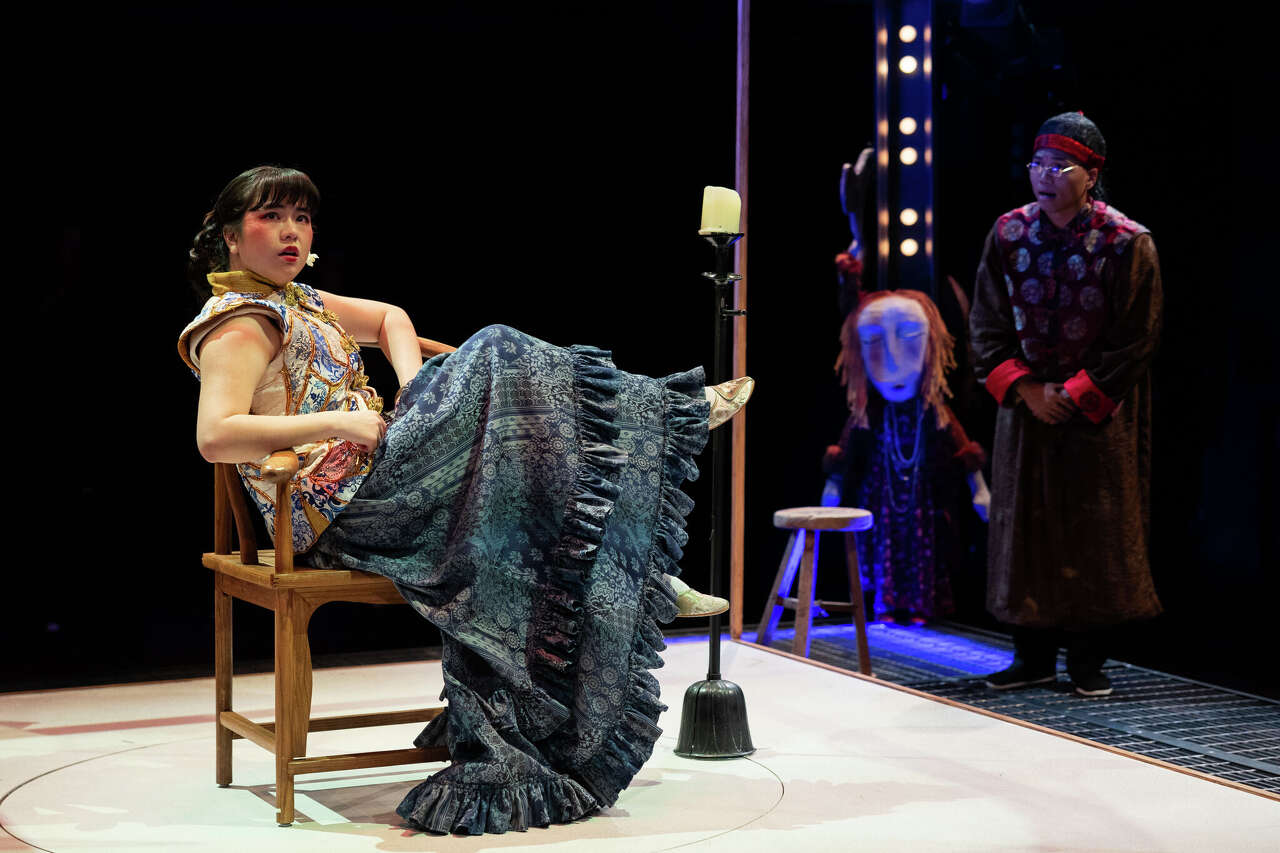
The play “The Chinese Lady” explores Afong Moy’s life through a mesmerizing production at Stages. Alexandra Szeto-Joe portrays Afong Moy, delivering a remarkable and memorable performance. She speaks directly to the audience, beginning her form of indentured servitude as a traveling specimen of Chinese culture from her teens to her senior years. Her performance demands representing all things “Chinese” for a curious public willing to pay money to do so.
Cultural Representation and Identity
Afong Moy’s costumes evolve over time, becoming less formal and more Westernized. As she ages, she gradually loses her Cantonese language and the culinary fare of her childhood. This transformation highlights her struggle to maintain her identity while adapting to a new culture. She is eventually replaced by a younger Chinese woman, a painful reminder of her obsolescence. Despite this, her final words echo themes of perseverance and victory.
She is accompanied by Atung, played by Lloyd Wayne Taylor, who assists during her performances. While he remains quiet for most of the play, his simmering rage comes to a boil as the narrative progresses. His choice words reveal the impact of deferred dreams and the challenges faced by those in similar situations.
Thought-Provoking Themes
The play addresses a range of thought-provoking issues, including the cultural appropriation of tea, the tradition of foot-binding, the Opium Wars, and language barriers. Afong Moy reflects on how cultural myths often overshadow historical truths. She offers Montaigne-like moments, reminding the audience that while foot binding may be seen as “barbaric,” there are other Western practices such as corsets and slavery to consider.
Playwright Lloyd Suh explains that the play is not a recreation of history but a connection to the present. He emphasizes that the events on stage are relevant to current societal issues. The play aims to highlight the connections between political and personal experiences.
The Setting and Audience Experience
“The Chinese Lady” is performed in a theater-in-the-round configuration, creating a visually arresting set designed by Inseung Park. Musical moments by Firat Ozsoy complement Afong Moy’s restricted life, symbolizing her constant movement without progress. The set, featuring wooden furniture and Chinese décor (as perceived by Westerners), resembles a cage-like existence. This juxtaposition of themes and rhetoric of liberty highlights the physical freedom she gains later in the play, though it is not accompanied by financial security.
Audience members take on the role of decades of gawkers, including President Andrew Jackson, who have endured Afong Moy’s performances. Seated on the second floor, they literally look down on her, mirroring her metaphorical experience. This dehumanizing life she endures to survive in a new country, where she is regarded as an Oriental object rather than a real person, is impossible to ignore.
Impact and Legacy
With an imaginatively constructed set, striking costumes, and outstanding performances, “The Chinese Lady” brings to life a forgotten history. The play serves as a powerful corrective to the elision of such stories, imagining the spectrum of emotions experienced by someone regarded as “the Other.” It suggests that such dismissals contribute to division and rejection rather than understanding and connection.
There is no historical record of Afong Moy after 1850. However, this excellent production brings her story to life, ensuring she is a lady you will never forget. She asks the audience, “What do you think it feels like when they look at me?” And you know she isn’t talking about just when someone has purchased a ticket.









![[IMAGE: Best Travel Apps for Stress-Free Adventures United States]](https://www.mathhotels.com/wp-content/uploads/2025/09/608_Best_Travel_Apps_Stress_Free_Vacation_Hero.jpg)