
By Edward Carver
Ocean initiatives and management frameworks are widespread around the world— ranging from offshore power generation to coastal fish farming andfishing treaties— however, there is no uniform method to assess their fairness. Now, scientists have created an Ocean Equity Index aimed at filling this void.
The index, released alongside a study in the journalNatureOn January 28, there is a framework intended to assess the fairness of ocean-related projects using 12 standards and can be utilized by governments, businesses, and local or Indigenous communities.
“Unequal distribution is increasing,” stated Jessica Blythe, an associate professor of environmental sustainability at Brock University in Canada and the study’s primary author, in a statement.videoaccompanying the index’s launch. “A small number of companies are making billions in profits while underrepresented [communities] are left out of management decisions that impact them.”
The research was conducted by 27 scientists from various organizations globally. They state that the index is designed to assist marine environments and coastal populations in attaining “more favorable results” regarding ocean-related efforts.
“Once we begin monitoring equity, significant changes will become apparent,” Blythe stated.
[(https://imgs.MathHotels.com/wp-content/uploads/sites/20/2026/02/26153449/1.png)
The “conceptual framework” of the Ocean Equity Index. The team behind the index concentrated on three main forms of equity: recognition, procedure, and distribution. For each form, they identified two principles, and for each principle, two criteria, leading to the 12 criteria that are evaluated in the index and visible in the outer part of the circle. Image provided by Blythe et al. (2026).
Ocean-based economic activity hasincreased significantlyin recent years, discussions about fairness and justice in ocean-related meetings have increased. The concept of equity has been included in theglobal biodiversity framework(GBF), executed in 2022, and theagreementon the protection and responsible utilization of marine biological diversity in regions outside national control, which was finalized the subsequent year.
However, turning these commitments into truly fair results is challenging, experts note. A significant method for assessing equity has been theassessment of governance and equity at the site level(SAGE), but this is specifically designed for conservation initiatives, whether on land or in the ocean, and involves a lengthy, demanding procedure. (Phil Franks from the International Institute for the Environment and Development, a research organization based in the U.K., created SAGE and is also a co-author of the recent Ocean Equity Index study.)
The Ocean Equity Index was the result of three years of effort by theBlue Justice working groupManaged by the Foundation for Research on Biodiversity, a scientific organization based in France. Initially, those involved identified 150 criteria to assess fairness but decided to simplify the tool for ease of use, ultimately choosing 12.
“As we were creating the tool, we collaborated with various groups globally, and we continually heard, ‘please, we can’t manage a tool that needs two weeks of training and six weeks in the field,’ ” Blythe said to MathHotels.com.
The standards involve “human and Indigenous rights,” “inclusion and influence,” “transparency,” and “evaluation of harms.” The index isdownloadableas a spreadsheet, a user can evaluate an initiative against each of the 12 criteria, resulting in a total score.
To evaluate the index, the creators of theNaturestudy had it use it to evaluatesix initiativesRanging from a local Tanzanian fish-drying initiative to a multinational, intergovernmental ocean conference declaration. The average score for the six case studies was 68%, out of a maximum of 100%, with the project that scored the lowest at 44%.
[(https://imgs.MathHotels.com/wp-content/uploads/sites/20/2026/02/26153503/2.png)
Findings from case studies. The Ocean Equity Index was applied to evaluate six ocean-related projects. Each initiative received a score for each of the 12 criteria, which is shown by how much of the corresponding wedge is filled. The evaluators differed depending on the initiative; in most instances, their names are openly listed on the index’s website. Image provided by Blythe et al. (2026).
Blythe stated that efforts toward fairness were being “undermined in places such as the United States,” but this tool was intended for groups thatarefocused on promoting fairness. Several companies have shown interest in the index, which is best implemented from the beginning stages of a project, she mentioned.
Blythe stated that “the dream” would involve the index being established on a global scale — for instance, within the GBF’s“30×30” target, which calls for 30% of land and water to be safeguarded by 2030 via “equitably managed systems of protected areas and other effective area-based conservation methods.” She mentioned that the index is designed to be adaptable enough to evaluate global agreements as well.
However, not everyone believes the index is useful. Peter Jones, a retired professor of environmental governance at University College London in the U.K., who has conducted extensive qualitative researchresearchon fairness within marine conservation zones, raised concerns, stating in an email to MathHotels.com that the topic of fairness was “subjective, multifaceted, and intricate” and wasn’t suitable for numerical evaluations. He further mentioned that views on fairness differ significantly among various parties — for instance, a newly established marine protected area might be perceived differently by an Indigenous group compared to a global non-governmental organization — and evaluating fairness based on a single viewpoint could undermine democratic validity.
Blythe mentioned that equity is frequently neglected due to its complexity, and the index aims to tackle this issue; she further noted that it should be paired with thorough qualitative analysis whenever possible. She also stated that the index could help in “exploring various viewpoints” — different groups can complete the index for the same project.
Blythe mentioned that the index could potentially serve as a “tool of resistance” utilized by underrepresented communities to evaluate, for instance, an offshore oil and gas project in their vicinity. She emphasized that the actual scores are less significant than the conversation they provoke.
“The main objective is to enhance procedures within the water,” she stated.
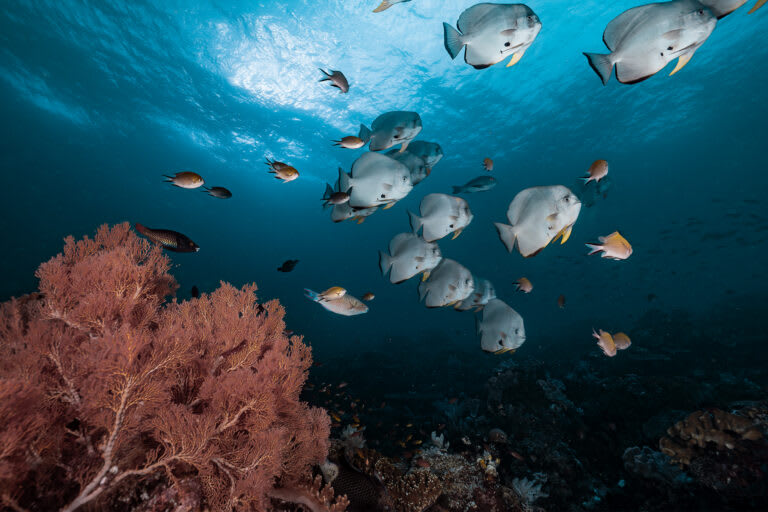
Banner image:A group of batfish in Raja Ampat, Indonesia. Photo by Noemi Merz /Ocean Image Bank.
Citations:
Blythe, J. L., Claudet, J., Gill, D., Ban, N. C., Epstein, G., Gurney, G. G., … & Zafra-Calvo, N. (2026). The Ocean Equity Index.Nature, 1-6. doi:10.1038/s41586-025-09976-y
Jouffray, J., Blasiak, R., Norström, A. V., Österblom, H., and Nyström, M. (2020). The blue acceleration: The path of human growth into the ocean.One Earth, 2(1), 43-54. doi:10.1016/j.oneear.2019.12.016
Jones, P. J., Stafford, R., Hesse, I., & Khuu, D. T. (2024). Diverse incentives are essential for more effective and fair management of marine protected areas.Frontiers in Marine Science, 11. doi:10.3389/fmars.2024.1412654
Feedback:Use this formTo reach out to the person who wrote this post, you can send them a message. If you’d like to leave a public comment, you have the option to do so at the bottom of the page.
This piece was first released onMathHotels.com