
Muscat Emerges as a Key Aviation Hub Amid Regional Turmoil
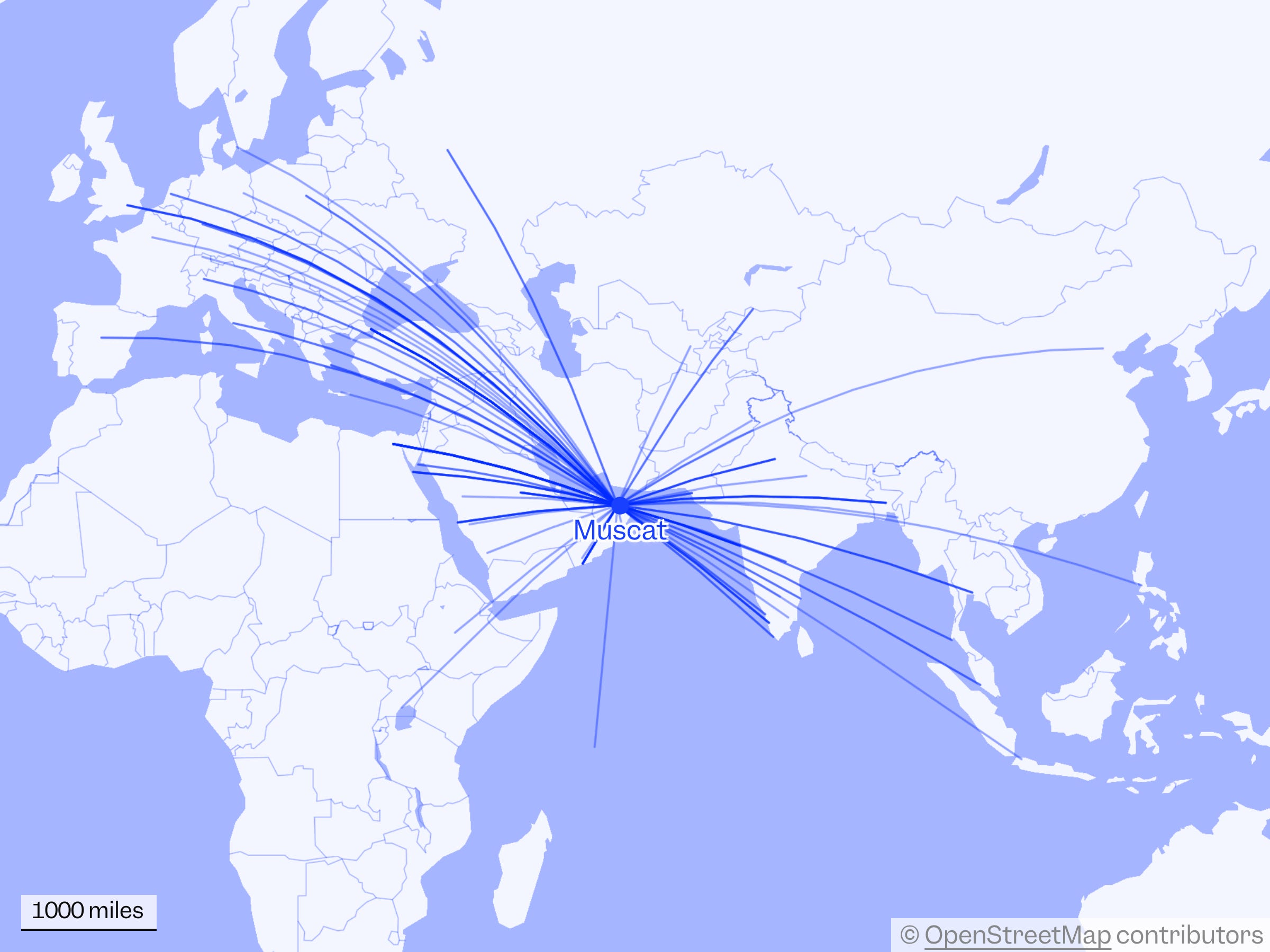
Muscat, the capital of Oman, has become a crucial point of transit for international travelers following recent disruptions in Middle Eastern air travel. With several Gulf countries closing their airspace due to heightened tensions, Oman has remained open, allowing it to serve as a temporary hub for airlines and governments.
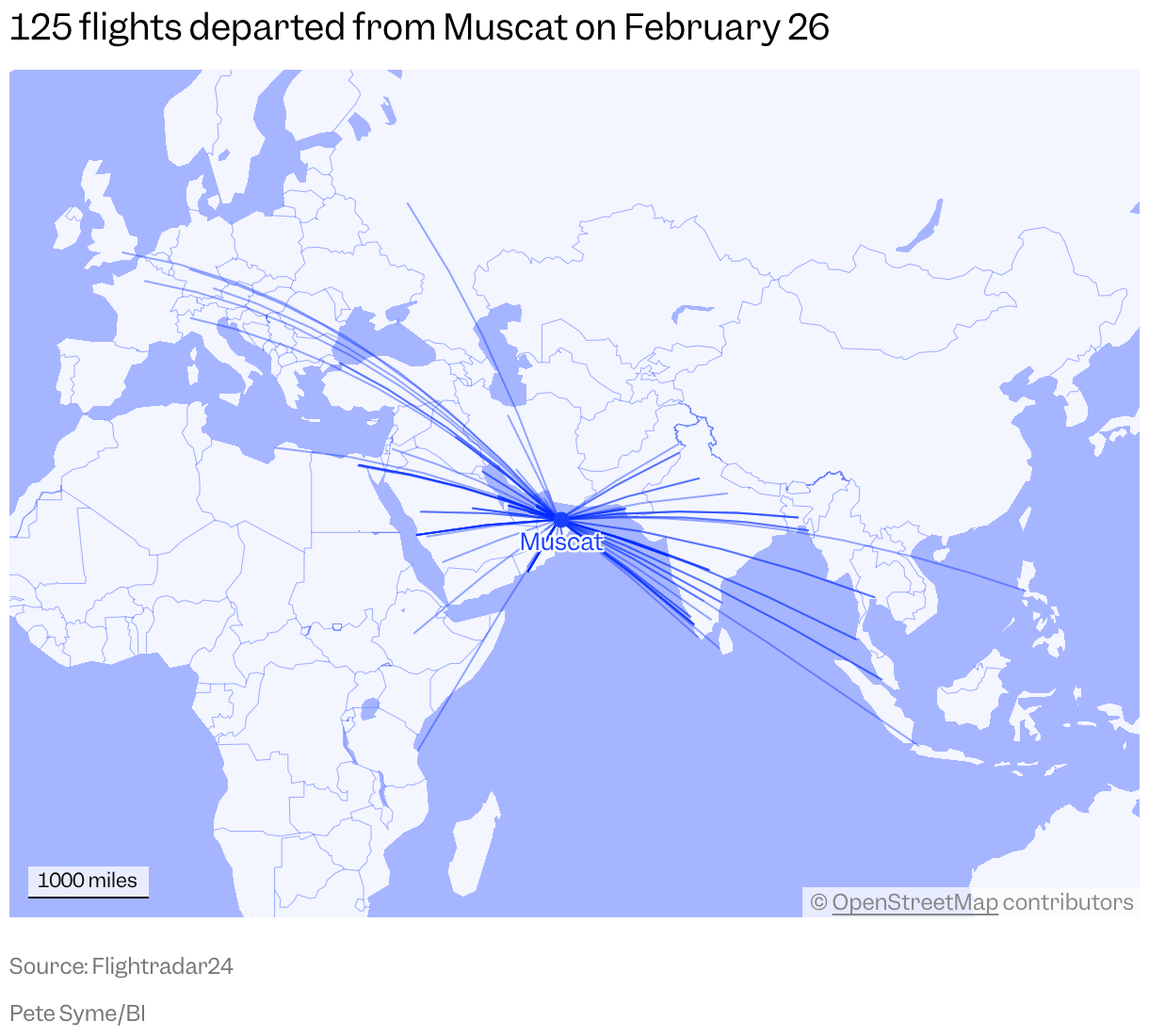
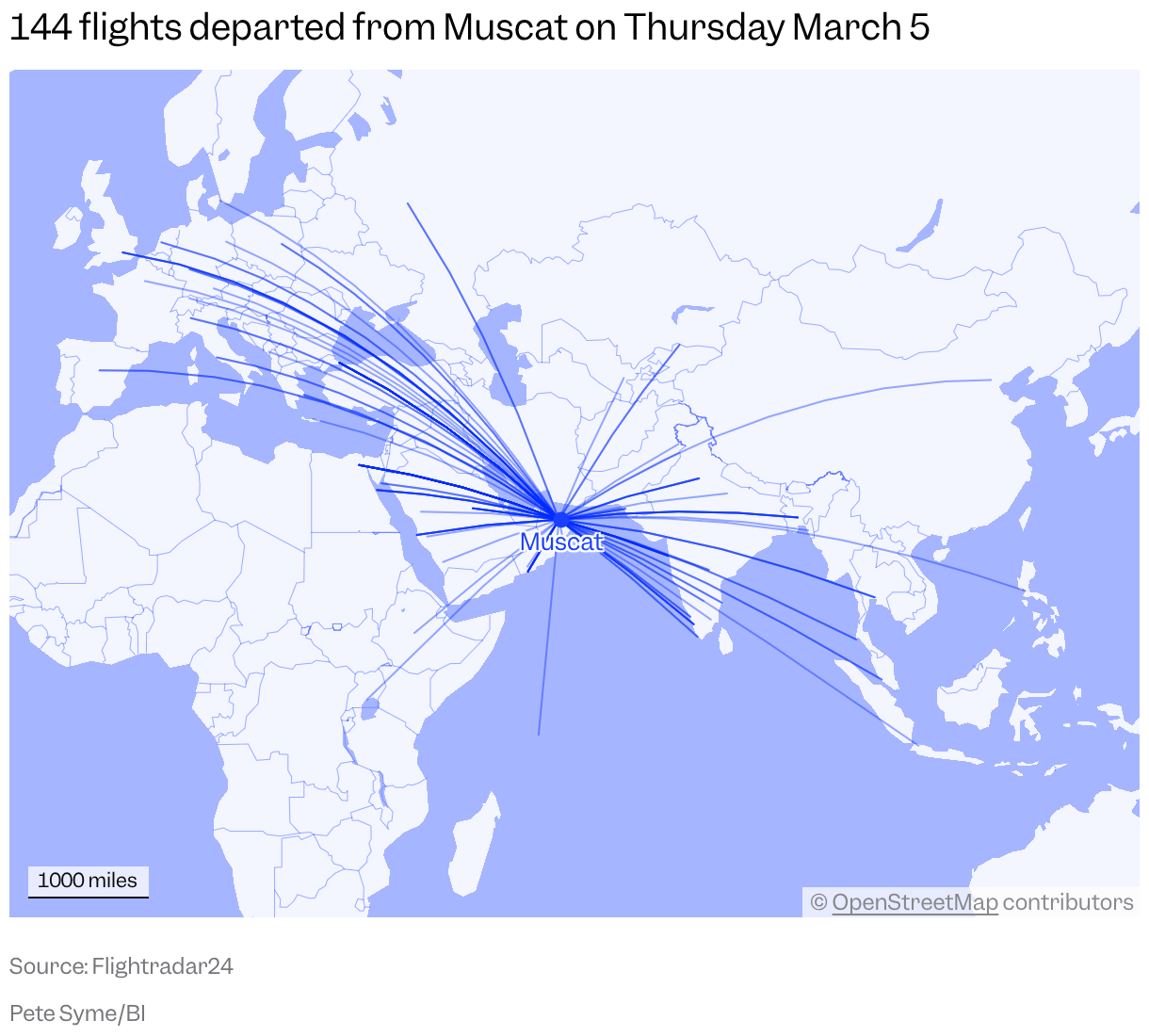
This shift has led to a significant increase in air traffic through Muscat International Airport. According to data from Flightradar24, 144 flights departed from Muscat on Thursday, compared to 125 a week earlier. The airport has also seen an influx of private aircraft, which now account for nearly one-third of all takeoffs and landings.
Increased Air Traffic and Challenges
The surge in demand has placed pressure on local infrastructure. Oman Air has advised passengers to arrive at the land-border crossing 12 hours before their flight’s departure, highlighting the challenges of managing such a high volume of travelers.
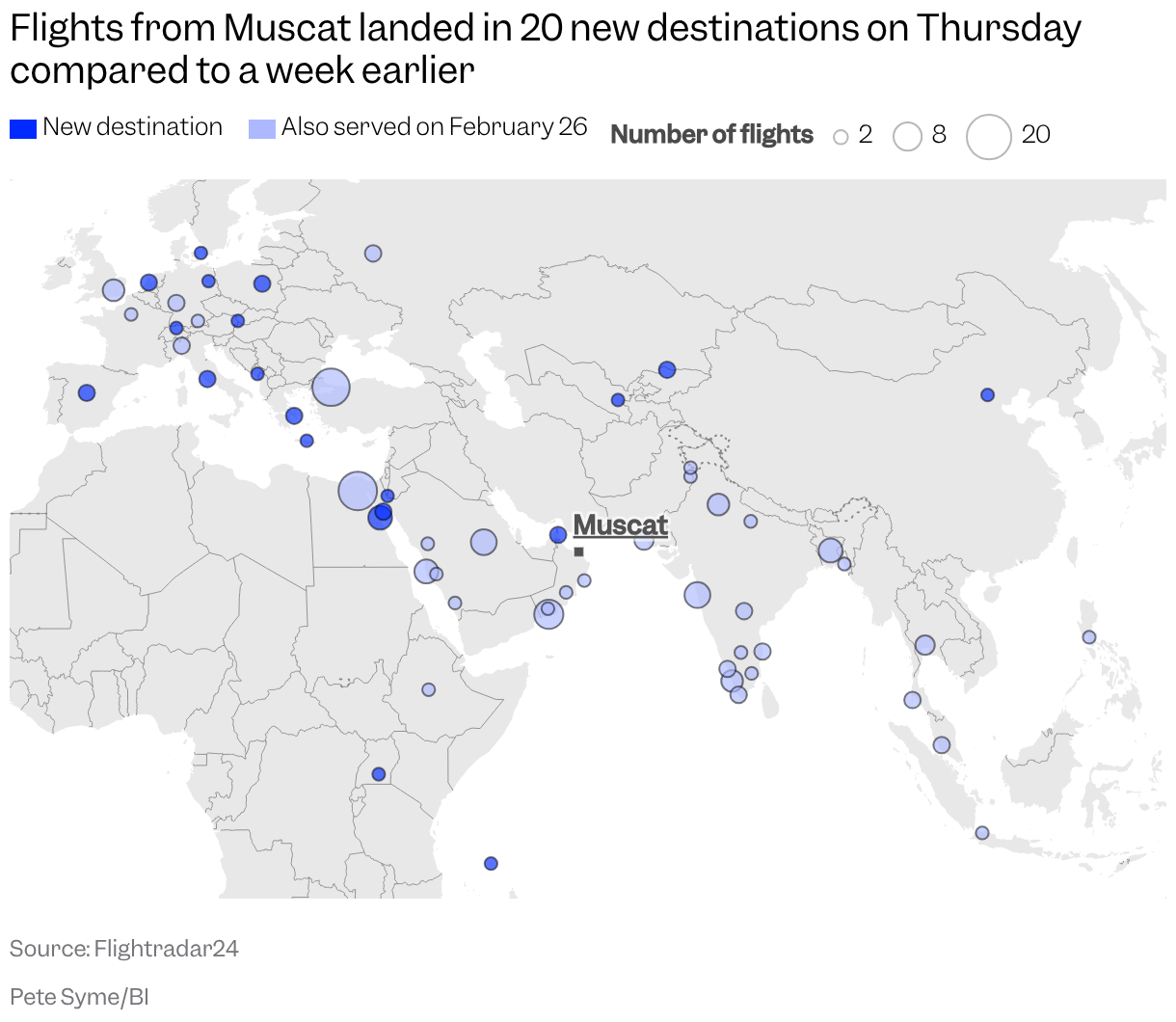
Business Insider created three maps that illustrate how Muscat International Airport has grown in significance over the past seven days. These maps show the expansion of routes and the increased number of destinations served by flights departing from Muscat.
Previously, Dubai and Salalah were the most common destinations for flights leaving Muscat. However, on Thursday, Cairo and Istanbul became the top destinations, with the Egyptian capital increasing from four flights to 15, and the Turkish capital from two flights to 12. This shift allows passengers to more easily connect to other parts of the world.
Strategic Flights and Repatriation Efforts
Many of the flights passing through Muscat are not direct but rather part of longer journeys. For example, 12 of the 144 flights made brief stops before continuing to Europe. One notable example is an Austrian Airlines special flight to Riyadh, which was depicted only in its first leg before it continued to Vienna.
Other airlines have also used Muscat as a stopover point. An Airbus A320 chartered by the British government stopped in Cairo before reaching London. Slovenia also chartered a plane that went to Jordan before continuing to Ljubljana. Additionally, the Czech airline Smartwings operated three flights that stopped in Hurghada, Egypt, before heading to Oslo.
Airlines have also been operating direct flights to support repatriation efforts. British Airways, which does not usually serve the country, has flown from Muscat to London three times this week. Qatar Airways is also operating flights from Muscat while its home airspace is closed. Six of its airplanes departed the Omani capital on Thursday, flying to Madrid, Rome, Copenhagen, Amsterdam, Berlin, and London.

Infrastructure and Operational Advantages
Oman Airports has stated that it is well-positioned to support airlines due to its 24-hour operations and lack of constraints on the number of takeoffs and landings. It has also committed to helping new airlines “facilitate and expedite regulatory approvals wherever possible.”
Despite being a smaller airport compared to others in the region, Muscat’s strategic location and operational flexibility have made it a critical player during this period of uncertainty.
Regional Context and Geopolitical Factors
The Middle East has long been a major travel hub, with airlines like Qatar Airways, Etihad Airways, and Emirates playing a key role in connecting travelers worldwide. Dubai International Airport, for example, handled around 95 million passengers last year, making it the world’s busiest for international traffic.
In contrast, Muscat handled approximately 12 million passengers in 2025. While the UAE has partially reopened its airspace, flights are still strictly limited. Dubai International is currently operating at about a fourth of its typical level, according to Flightradar24.
However, Emirates has expressed confidence that it will return to 100% of its network within the coming days.
Oman’s Unique Position
Oman maintains friendlier relations with Iran than its Gulf neighbors, which has allowed it to play a mediating role in regional discussions. Despite this, an Omani port was hit by Iranian drones on Tuesday. Iran’s foreign minister, Abbas Araghchi, stated that this “was not our choice” because military units are “independent and somewhat isolated.”
Conclusion
As the situation in the region continues to evolve, Muscat’s role as an aviation hub is likely to remain significant. Its ability to handle increased traffic and provide essential services for travelers highlights its importance in the broader context of Middle Eastern air travel.