
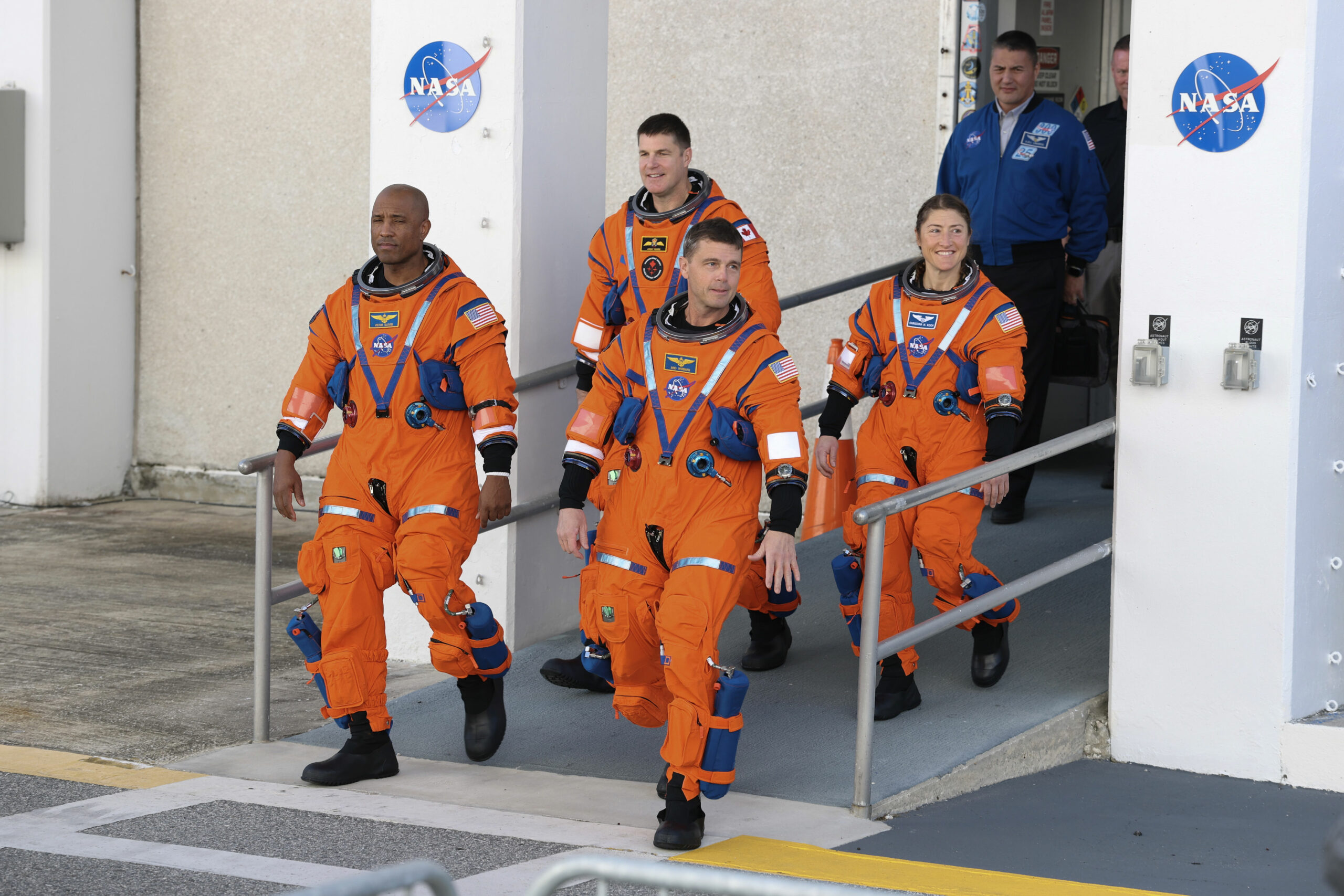
CAPE CANAVERAL, FLORIDA – DECEMBER 20: The Artemis II crew – (L-R) pilot Victor Glover, mission specialist Jeremy Hansen of CSA (Canadian Space Agency), commander Reid Wiseman and mission specialist Christina Koch – rehearse a walkout from the Neil A. Armstrong Operations and Checkout Building at NASA’s Kennedy Space Center in Florida on December 20, 2025 in Cape Canaveral, Florida. The astronauts are rehearsing for the scheduled February 2026 10-day mission that will carry them around the Moon and back to Earth. (Photo by Joe Raedle/Getty Images)
Spaceflight can alter the physical position of the human brain inside the skull. According to reports, researchers led by Tianyi (Erik) Wang and Rachael Seidler have found that astronauts experience upward and backward brain shifts after time in space.
The extent of these shifts was larger for astronauts with longer missions aboard the International Space Station. MRI scans revealed that some brain areas moved upward by more than 2 millimeters, while other regions showed minimal movement.
These findings indicate that microgravity directly affects brain location and structure, with most changes returning to baseline within months after returning to Earth.
How Microgravity Affects Brain Position During Spaceflight
Brain Movement and Microgravity
On Earth, gravity pulls fluids and tissues toward the center of the planet, maintaining a stable position of the brain and surrounding cerebrospinal fluid. In microgravity, this force disappears, causing fluids to shift toward the head.
Without the downward pull of gravity, the brain floats within the skull and is subjected to forces from surrounding tissues. Previous studies measured average brain position changes, but these can mask shifts occurring in specific regions. The change in fluid distribution contributes to a puffy face commonly observed in astronauts.
Microgravity also alters the balance between the brain, cerebrospinal fluid, and surrounding tissues, affecting the forces acting on the brain.
MRI Analysis of Astronaut Brains
Researchers analyzed MRI scans from 26 astronauts who spent varying lengths of time in space, ranging from several weeks to over a year. Each astronaut’s skull was aligned across preflight and postflight scans to track relative brain movement.
The brain was divided into more than 100 regions, allowing scientists to observe shifts that whole-brain averages would miss. The scans consistently showed upward and backward movement, with longer missions producing larger shifts. Areas near the top of the brain showed movements of over 2 millimeters, while other regions remained relatively unchanged. This approach allowed detection of patterns missed in studies that looked only at the average brain.
Post-flight MRI comparisons showed that some regions moved more than others depending on mission duration.
Regional Differences in Brain Shifts
Specific regions involved in movement and sensory processing exhibited the largest shifts. Structures on opposite sides of the brain moved toward the midline in opposing directions, which cancels out in whole-brain averages. Most shifts and deformations returned to preflight positions within six months, but backward shifts showed slower recovery due to gravity’s downward pull.
The study also found a correlation between larger shifts in sensory-processing regions and postflight balance changes, although astronauts did not report headaches or cognitive symptoms linked to brain movement.
Some brain regions showed changes of over 2 millimeters, which is significant in the limited space inside the skull. Opposing shifts on each hemisphere explain why earlier studies missed these localized changes.
Implications for Long-Duration Missions
NASA’s Artemis program aims to extend human spaceflight, making it essential to understand brain responses to microgravity. Tracking these shifts allows researchers to assess long-term effects and develop countermeasures for astronauts.
Understanding microgravity’s influence on brain position can help space agencies design safer missions and inform strategies for extended human presence in orbit or on other planets. Knowing how the brain moves and subsequently recovers allows agencies to better evaluate physiological risks. These findings may help inform preparation for missions that last several months or longer in microgravity environments.















![[IMAGE: Best Travel Apps for Stress-Free Adventures United States]](https://www.mathhotels.com/wp-content/uploads/2025/09/608_Best_Travel_Apps_Stress_Free_Vacation_Hero.jpg)