
As tensions between the United States and Iran continue to rise, a growing number of travelers are finding themselves caught in the crossfire of geopolitical conflict. With airspaces closing and airlines prioritizing their financial interests over passenger safety, thousands of people are left stranded in volatile regions. The situation has created a crisis that highlights the limitations of the global airline industry during times of war.
A Growing Crisis
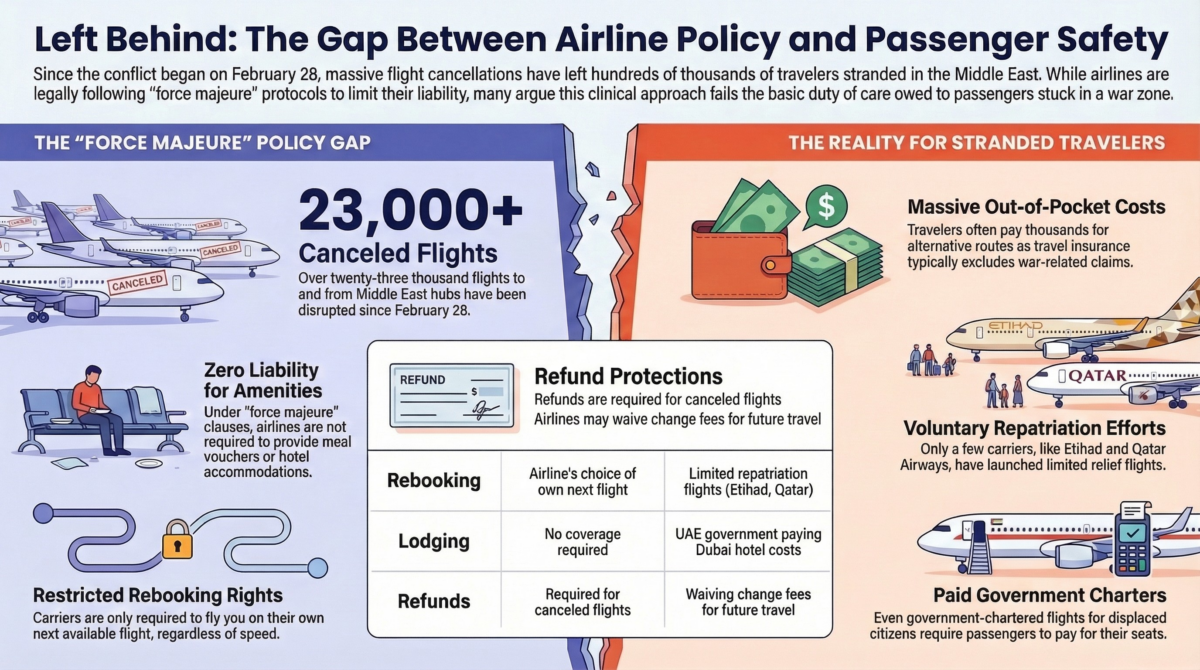
The scale of disruption is staggering. Since the conflict began on February 28, more than 23,000 flights to and from Middle East hubs have been canceled. Major airports such as Dubai International and Doha’s Hamad International have faced repeated closures, leaving passengers scrambling for any available seat. For many, the idea of being stranded in a war zone is not just a logistical nightmare—it’s a life-threatening scenario.
The U.S. State Department has advised travelers to “depart now,” but this guidance feels hollow when there are no flights available. Many readers have expressed frustration over these orders, especially when they have no means to leave. While the State Department has begun chartering flights for displaced Americans, these are not free—travelers must cover the costs themselves.
Airline Policies During War
When it comes to airline policies during wartime, the rules are clear: Airlines are only required to fly you on a flight of their choosing, not necessarily the one that gets you home the fastest. This can mean delays ranging from days to weeks—or even longer. In airline parlance, war is considered a “force majeure” event, meaning it is an event beyond the airline’s control. As a result, airlines are not obligated to cover any expenses related to delays, including meal vouchers or hotel stays.
Even with this legal protection, some airlines have gone above and beyond. Carriers like Etihad and Emirates have operated limited repatriation flights to help clear the backlog. Qatar Airways has also launched relief flights to European cities such as London and Berlin to assist those left behind. Additionally, the UAE government is covering accommodation costs for stranded passengers in Dubai.
However, the bottom line remains: Airlines don’t have to do anything except put you on their next available flight, which might be tomorrow, next week—or never.
A Question of Responsibility
This raises a critical question: Are airlines doing enough? Or are passengers expecting too much?
A recent survey revealed that a significant number of travelers believe airlines have failed them during the Iran conflict. The responses varied, with some expressing frustration over the lack of support and others acknowledging the challenges airlines face.
Key Questions Raised by Travelers
- If you said yes, tell us why. Are you currently stranded or facing massive out-of-pocket costs?
- If you said no, same question. Has an airline gone above and beyond to rebook you?
- Do you think the government should mandate that airlines fly passengers out of conflict zones on the first available flight, regardless of the carrier?
Reader Perspectives
The debate over who should bear the responsibility for stranded passengers has been intense. Many readers argue that the government—not the airlines—should be responsible for wartime travel disruptions. They point out that airlines did not start the conflict and should not be expected to cover the fallout. Others emphasize that it is unrealistic to expect carriers to risk their crews and expensive aircraft by flying into active war zones.
Despite these arguments, some readers criticize how airlines are handling the crisis on the ground. Complaints about poor communication and a lack of human support have been common. Some have accused airlines of exploiting “force majeure” clauses to hold passengers’ money hostage with expiring vouchers instead of issuing immediate refunds.
On the other hand, some voices have pushed back against the criticism, pointing out the physical and financial constraints airlines face. With thousands of flights canceled and airports closed, airlines are losing significant revenue and cannot simply ignore airspace restrictions.
Final Thoughts
While the situation is undoubtedly complex, many believe the travel industry needs to step up and provide a lifeline to those affected. If airlines are unwilling to do so, the government may need to play a larger role in ensuring the safety and well-being of stranded travelers.