
A Small Tool with Big Implications
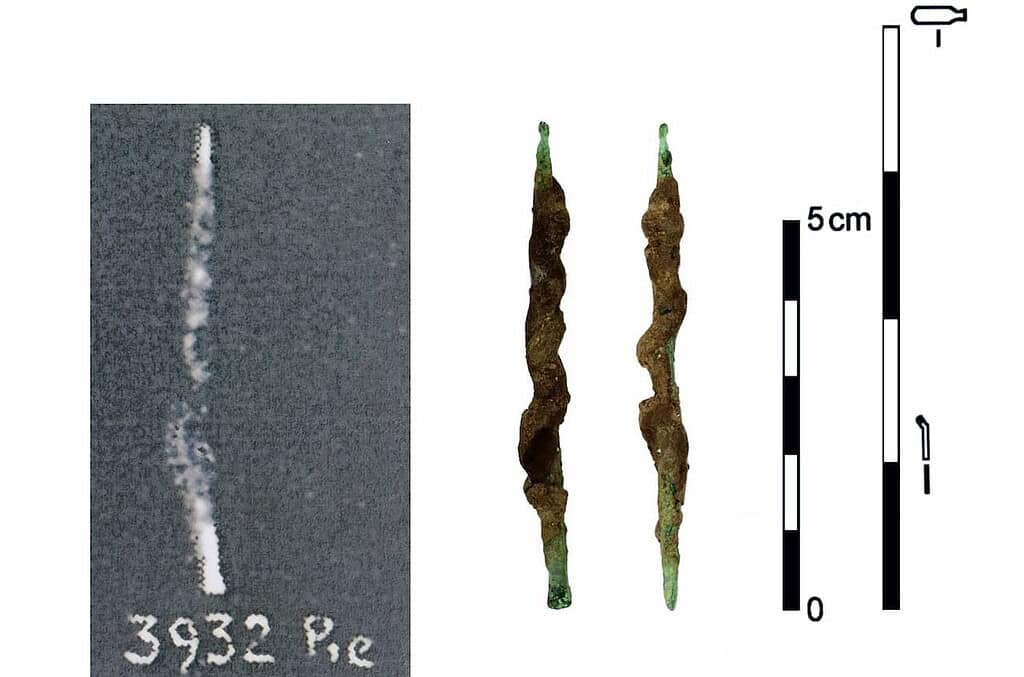
In the collections of the Museum of Archaeology and Anthropology at the University of Cambridge lies a small copper-alloy tool from a cemetery at Badari in Upper Egypt. Measuring just 63 millimeters in length and weighing about 1.5 grams, this seemingly unremarkable object has recently sparked renewed interest among researchers.
When it was first introduced to the public in the 1920s, archaeologist Guy Brunton briefly described it as “a little awl of copper, with some leather thong wound round it.” With minimal documentation beyond that line, the object remained largely overlooked for many years.
However, a new re-examination has revealed that the piece may not have been an awl at all, but rather a drill bit used with a bow drill. This discovery positions it as one of the earliest identified rotary metal drills from ancient Egypt, dating back to the Naqada IID period (roughly 3300–3000 BCE). This era marks the second pre-dynastic archaeological stage centered around the Naqada region of Upper Egypt, before the rise of the first pharaohs.
The research, conducted by scientists from Newcastle University and the Academy of Fine Arts Vienna, was published inEgypt and the Levant.
A Forgotten Object Reconsidered
The tool was found in Grave 3932 at Badari, the burial site of an adult man who lived during the Predynastic period, centuries before Egypt became a unified kingdom. For many years, the object’s significance went unnoticed until researchers recently examined it using modern techniques.
Under magnification, the team observed distinctive wear patterns at the tip: fine circumferential striations, rounded edges, and a slight curvature at the working end. These marks suggest sustained rotary motion rather than simple pressure, indicating that the object had spun while drilling.
The researchers also reexamined a fragile detail wrapped around the shaft—six delicate coils of leather thong. Rather than being incidental debris, the team believes that the leather is likely a remnant of the bowstring that once powered the tool.
A cord wraps around a vertical spindle; the bit at its end does the cutting. Moving a bow back and forth spins the shaft rapidly, producing continuous rotation. The device allows a craftsperson to drill faster and with greater precision than twisting a tool by hand.
“The ancient Egyptians are famous for stone temples, painted tombs, and dazzling jewellery, but behind those achievements lay practical, everyday technologies that rarely survive in the archaeological record,” said Dr. Martin Odler, lead author of the study.
Together, the microscopic wear marks and preserved leather provide rare physical evidence that hints at how the tool was actually powered.
Pre-Pharaoh Technology
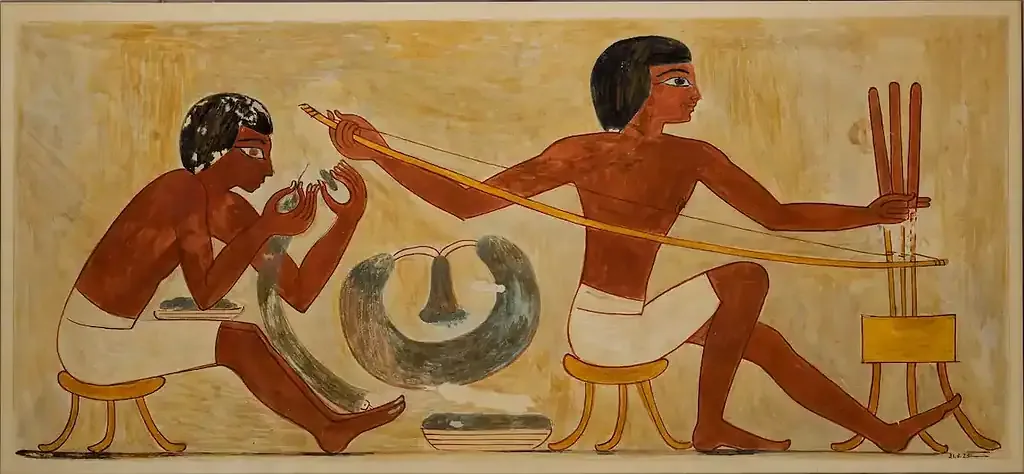
Bow drills are well known from later periods of Egyptian history. Archaeologists have found surviving examples from the New Kingdom in the second millennium BCE, and tomb paintings show craftsmen drilling beads and wooden objects.
Scenes from tombs in the Theban necropolis near modern Luxor depict artisans operating the devices in busy workshops. The Badari artifact pushes the origins of this technology much further back in time.
“This suggests that Egyptian craftspeople mastered reliable rotary drilling more than two millennia before some of the best-preserved drill sets,” Odler added.
Drilling technology was essential to ancient craft industries. Without such tools, many of the objects associated with ancient Egypt, including carved stone vessels, intricate jewelry, and finely constructed furniture, would have been far more difficult to produce.
The object’s chemical composition adds another layer to the story.
Portable X-ray fluorescence analysis showed that the tool used an unusual copper alloy containing arsenic and nickel, with notable amounts of lead and silver. According to co-author Jiří Kmošek, this mixture would have produced a harder and visually distinctive metal compared with pure copper.
Such a composition may reflect deliberate alloying choices aimed at improving the performance of the tool. A harder metal would be particularly useful for drilling resistant materials repeatedly.
The metals may also point to broader networks of knowledge and exchange. Some elements could reflect ore sources in Egypt’s Eastern Desert or connections linking Egypt with regions of the eastern Mediterranean during the fourth millennium BCE.