50 Songs for 50 States of America, Part 1 Welcome to MathHotels.com, and today we’re listening to songs that best capture each state in the U.S., in alphabetical order, up to Missouri.
“Sweet Home Alabama” (1974) by Lynyrd Skynyrd
Alabama Although they are from Florida, Lynyrd Skynyrd is so distinctly Southern rock that they created an anthem for the quintessential Southern state. “Sweet Home Alabama” was a reply to Neil Young’s “Alabama” and “Southern Man,” which used stereotypes to criticize current social issues in the region. The post-Watergate diss track highlights the hypocrisy of blaming the entire South for the corruption and prejudice of its politicians. Mostly, however, it’s a tribute to Alabama’s unique charm and warmth, supported by an unforgettable guitar riff. The worldwide hit “Sweet Home Alabama” is naturally a mainstay of classic rock culture in the Deep South. And it serves as a symbol of the cozy spirit of the Yellowhammer State.
“North to Alaska” (1960) by Johnny Horton
Alaska – Not two years after Alaska became the 49th state of the United States, the Western film “North to Alaska,” set in the north, captivated audiences. The theme song was a more serious hit in the country music style, as singer Johnny Horton had passed away in a car accident just days before the movie came out. Over time, it has become a less well-known film featuring John Wayne, but Alaskans still enjoy that song. The warm tones complement Tillman Franks and Mike Phillips’s lively Gold Rush story to portray the land’s folk-inspired spirit of adventure. As this has only developed over the years, “North to Alaska” seems more like a tribute to Horton and the theme song to the entire Last Frontier.
“Arizona” (1981) by Rex Allen, Jr.
Arizona: The son of the famous “Arizona Cowboy” grew up considering all of America as his home. However, his father’s home held a unique place in his heart, prompting him to compose a tribute in the form of a heartfelt love song. “Arizona” also stands as the clearest representation of Rex Allen Jr.’s approach to authentic traditional country music within contemporary sounds. Although the Copper State has evolved since its establishment, the spirit of the frontiersman remains strong. As a result, Allen’s “Arizona” was chosen as an “alternate” state song just one year after it was released. It might be more of a regional favorite, but it captures the essence of the beauty and devotion associated with a community.
“Arkansas” (2020) by Chris Stapleton
Arkansas – Who claims that Arkansas is dull? The state’s atmosphere and vastness have been clearly reflected in a unique musical style, but it was Kentucky country artist Chris Stapleton who beautifully captured it. The lively Southern rock track “Arkansas” tells the story of how he and bassist J. T. Cure had to pick up a car in Oklahoma and drive it to his home in Nashville, Tennessee. During their journey, they discovered a vibrant and hospitable culture stretching from the Ozark Mountains to the large city of Little Rock. The residents quickly adopted “Arkansas” as a powerful and genuine reflection of their defining character. Naturally, they and Stapleton would concur that there is a deep musical heritage behind this contemporary regional masterpiece.
“Hotel California” (1977) by Eagles
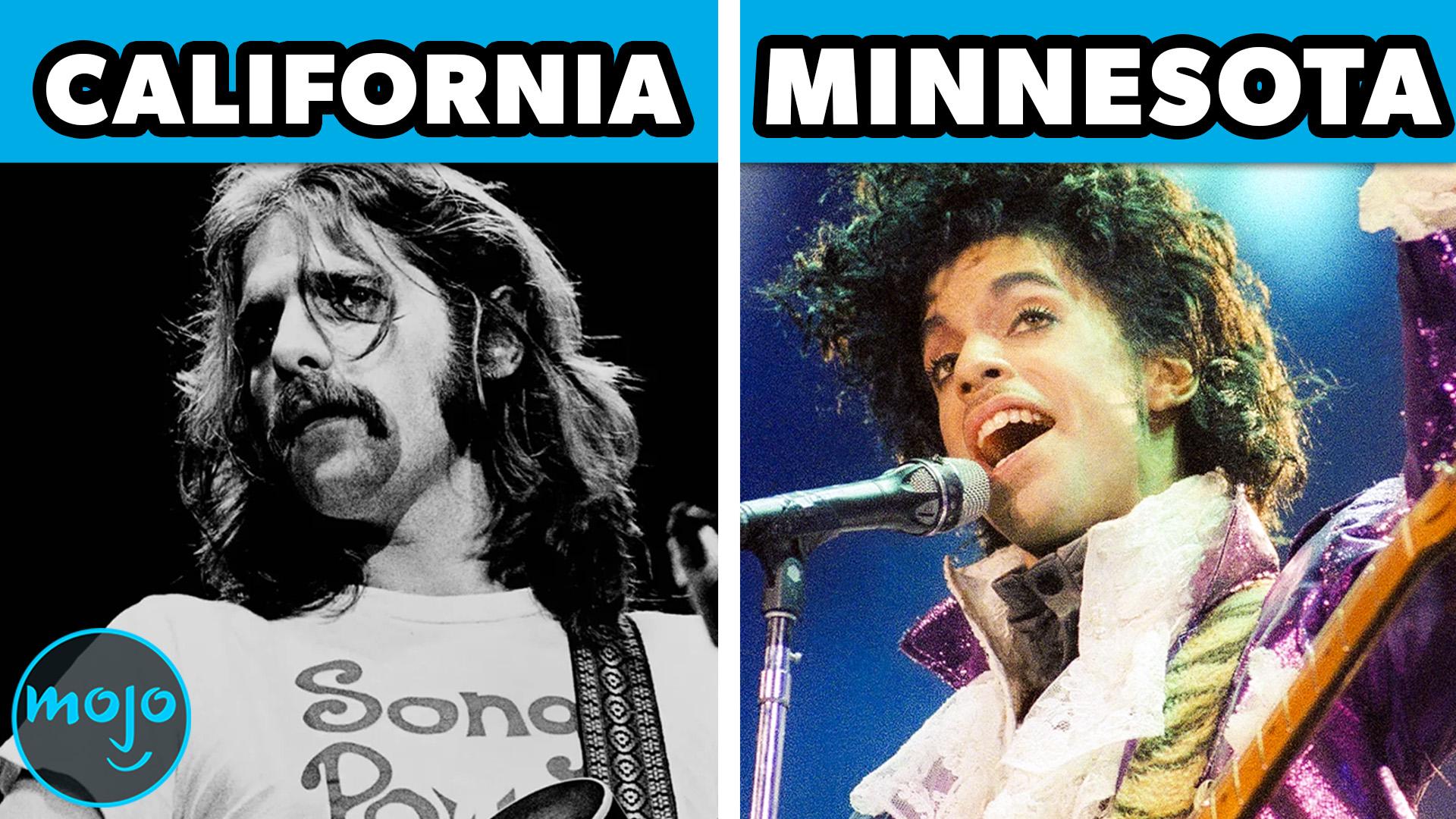
California: How can you narrow down a music culture as expansive and varied as California’s? The Eagles managed to do this uniquely by naming their major work “Hotel California.” This eclectic epic about a mysterious desert paradise refers to the very mythology of this legendary place. Naturally, the folk and psychedelic tribute to 1960s counterculture leaves much open to interpretation. It certainly presents a vivid image of the romance and indulgences of modern America, along with an eerie rhythm, a catchy chorus, and one of the greatest guitar duos of all time. “Hotel California” is ultimately a rock masterpiece that captures the mysterious spirit of the Golden State. If it’s truly this captivating, why would you ever want to leave?
“Rocky Mountain High” (1972) by John Denver
Colorado: John Deutschendorf’s stage name was only the beginning of the folk musician connecting his career to his chosen home state. This reached its peak with “Rocky Mountain High,” a depiction of how he moved to and fell in love with Colorado. It also considers how the area’s beauty has been harmed by industrialization. The seemingly deep ballad became so popular that John Denver was named the state’s poet laureate two years after its release. In 2007, it was recognized along with “Where the Columbines Grow” as Colorado’s official state anthem. Among all the honors Denver composed for the State of Colorado, “Rocky Mountain High” is the most sincere love letter a place could wish for.
“Connecticut” (1945) by Bing Crosby and Judy Garland
Connecticut: The dream of one of America’s most romantic states was refined by two of the nation’s most talented stars from the golden era. Songwriters Hugh Martin and Ralph Blane, who contributed to “Meet Me in St. Louis,” collaborated again with Judy Garland to create “Connecticut,” a duet featuring Bing Crosby. This lively ballad suggests that there may be no more delightful location than the Nutmeg State. Given how it portrays community, education, and nature, it’s challenging to disagree. The Land of Steady Habits still embodies an old-fashioned idealized vision, making this 1940s hidden treasure feel even more timeless. At the very least, Crosby and Garland have the charm to make Connecticut seem like the perfect place for anyone.
“Delaware Slide” (1977) by George Thorogood and the Destroyers
Delaware The modest reputation of the First State has often been put to the test by its most famous rock star. Clearly, many people aren’t aware of George Thorogood and the Destroyers’ “Delaware Slide.” The rough-voiced blues artist recounts the typical tale of traveling along the famous Highway 95 after a breakup. Mostly, the eight-minute piece is an endlessly engaging jam driven by a slide guitar. It’s grand yet simple, blending traditional and contemporary elements that embody urban blues. It’s fittingly Delaware. Thorogood has certainly had more successful songs since this track, the closing number on his first album, helped establish him as a local icon. Nonetheless, “Delaware Slide” is the kind of classic American epic that exudes, “Liberty and Independence.”
“Seminole Wind” (1992) by John Anderson
Florida: The only thing that brings together the various distinct identities of Florida is the sunshine. However, real Floridians can detect a touch of everything in Apopka native John Anderson’s “Seminole Wind.” This upbeat country ballad celebrates the beauty of the Everglades, mentions Indigenous history, and expresses sorrow over the damaging effects of development. It’s not exactly a cheerful anthem for a popular tourist spot. Still, it became a commercial and critical success that helped Anderson make a comeback in the ’90s, even though the label worried it might be too locally specific. With its folk-inspired charm and complex themes, “Seminole Wind” particularly appeals to locals, and it may well convey more about Florida than any travel guide ever could.
“Georgia in My Mind” (1960) by Ray Charles
Georgia Composer Hoagy Carmichael worked with Stuart Gorrell to create “Georgia on My Mind” in 1930 as a tribute to his sister. The pop song was mistakenly promoted as Southern nostalgia for three decades until Ray Charles revived it. The native of Albany combined soul and country to elevate the heartfelt ballad into a deep affection for his home. This distinctive version made “Georgia on My Mind” an authentic American classic, as well as the favored style for many covers. It was also chosen as Georgia’s official state song in 1979. Although Hoagy Carmichael certainly deserves some credit, the only thing that comes to mind when Brother Ray takes us away is his incredible performance.
“Blue Hawaii” (1961) by Elvis Presley
Hawaii: Ralph Rainger and Leo Robin composed “Blue Hawaii” for the 1937 movie “Waikiki Wedding.” It became a popular standard until, two years after Hawaii became a state, another film linked it with Elvis Presley. His more emotional version not only enhanced the yearning in a love song originally written for Bing Crosby. It more effectively combined Polynesian elements with orchestral pop, contributing to the integration of Hawaiian folk music into American mainstream culture. The film “Blue Hawaii” might have created a romanticized image of the new state by exoticizing its native culture. However, Presley’s highly popular soundtrack represented a vibrant identity that still echoes in both local and global pop culture.
“Private Idaho” (1980) by The B-52’s
Idaho, Georgia, and the new wave pioneers The B52’s didn’t perform in Idaho until three decades after the release of “Private Idaho.” The state was mentioned along with a pool to symbolize a location of seclusion and enigma. Fred Schneider also claimed to be referencing the paranoia of a private investigator – pardon the pun. It turns out the strangely danceable track isn’t too different from the quirky nature of its namesake. Idahoans unexpectedly adopted it as a song representing their values of nature and independence. Its unconventional image was strengthened in 1992 when filmmaker Gus Van Sant titled his cult hit “My Own Private Idaho.” Whether The B52’s intended to capture the essence of the Gem State, they became local heroes in 2011.
“Chicago” (2005) by Sufjan Stevens
Illinois: The cultural diversity of Illinois was so profound that Sufjan Stevens from Michigan felt compelled to explore it through a concept album. It’s no surprise that the track named after the state’s largest city became the biggest success. However, “Chicago” goes beyond merely representing urban ideals that can be heard in the indie folk song’s grand orchestration. It captures the adventurous spirit of an entire state that Stevens fell in love with during his childhood. Only someone from the area would easily recognize the references to history, local legends, and the poet Carl Sandburg. This intricate anthem remains Stevens’s most popular song and a particularly detailed tribute to the cultural heart of the Prairie State. Naturally, the entire album “Illinois” is an ethnographic masterpiece.
“Small Town” (1985) by John Cougar Mellencamp
Covering just over 10 square miles, Seymour, Indiana is certainly not a big city. However, John Mellencamp’s heartland rock feels more expansive than ever on “Small Town.” This deeply personal anthem honors his childhood and the sense of community amidst the challenges of modern life. Mellencamp aimed to challenge the traditional underdog mindset of seeking success in a major city. Despite not being released as a single, “Small Town” was highly appreciated for its catchy melody and genuine emotions, solidifying the singer’s status as a beloved figure in Middle America. The song has since been embraced by the broader Heartland region, as well as some political campaigns. It holds a special place in the small communities of Indiana.
“Stubborn in Iowa” (1957) by Meredith Willson
Iowa Although “The Music Man” was massive on Broadway, it holds an even greater significance in the small state of Iowa. Meredith Willson, from Mason City, infuses each musical number with the charm of his hometown, particularly “Iowa Stubborn.” This title is ironic because the residents of River City swarm the traveling salesman Charlie Cowell with tales of their gentle demeanor. While it wouldn’t be wise for outsiders to test that patience, the energetic song reflects the distinct humility that Iowans are proud of. “The Music Man” and its movie version helped popularize the mythical Midwestern ideal as embodied in one area. Iowans, in particular, cherish the affectionate term “Iowa Stubborn.”
“Wichita Lineman” (1968) by Glen Campbell
Kansas The essence of Kansas influenced Oklahoma songwriter Jimmy Webb and Arkansas country artist Glen Campbell during a recording session in Hollywood. This could not have been achieved without the likes of the “Wichita Lineman,” whose tale is conveyed with a frontiersman’s determination and a focus on the beautifully rugged aspects. It is all elevated by the emotional hooks of the renowned session group the Wrecking Crew. However, the lyrics’ blend of Western toughness and contemporary concepts truly resonated with the ambiguous identity of Kansans. Webb’s ballad became not only one of Campbell’s most successful tracks, but is also regarded as a modern American classic. And if its intricate identity connects with anyone, it’s the people of Kansas.
“Blue Moon of Kentucky” (1945) by Bill Monroe
Kentucky, known as the Bluegrass State, is a fitting title for the place where a music genre was born. It was specifically crafted by Bill Monroe, blending the romantic folk music of British immigrants with the emerging Appalachian Americana. With a sound and narrative that is quite captivating, “Blue Moon of Kentucky” makes heartbreak seem romantic. Monroe’s masterpiece so vividly portrays the land’s natural beauty and simple spirit that it became one of the defining American standards of the 20th century. More prestigious than the numerous covers was its designation as the official bluegrass song of Kentucky in 1988. Although “Blue Moon of Kentucky” is the clear choice, this implies there are many songs across various genres that tell this state’s story.
“Jambalaya (On the Bayou)” (1952) by Hank Williams
Louisiana: The Alabama country icon Hank Williams owed his radio breakthrough and his wife, Billie Jean Horton, to Louisiana. There was also a connection to Cajun culture that resulted in an authentic anthem. Although “Jambalaya (On the Bayou)” is somewhat stereotypical with its references to Creole traditions and food, it ultimately celebrates a distinct subculture that resonates throughout Louisiana with its zydeco-influenced honky-tonk style. The lively “Jambalaya” is thought to be the most covered song in Williams’s highly influential collection. It remains especially popular in Cajun Country, where it consistently brings together a melting pot of cultures for a good time.
“Ballad of the 20th Maine” (2015) by The Ghost of Paul Revere
Maine: Continuing the legacy of New England’s beloved patriot, The Ghost of Paul Revere introduced a contemporary take on American folk music. “Ballad of the 20th Maine” holds a special place for Portlanders as it tells the story of a regiment that played a crucial role in the Union’s triumph at the Battle of Gettysburg. This battle song honors these men’s sacrifice with elements of Irish folk music, which makes it somewhat challenging for mainstream audiences. That changed when it was officially recognized as Maine’s ballad in 2019 for the state’s bicentennial. Since then, “Ballad of the 20th Maine” has developed a dedicated following based on its acclaim, but it has always been deeply connected to the cultural and historical identity of Mainers.
” Baltimore ” (1978) by Nina Simone
Maryland: Randy Newman’s 1977 song about Maryland’s capital was not particularly complimentary. Just a year later, the High Priestess of Soul performed “Baltimore” with greater understanding and affection for the city. Producer Creed Taylor included a jazzy reggae style in her gentle interpretations of the human stories amid the urban decay. Nina Simone was openly disappointed by the unusual style of the song and the album with the same name. However, fans regard “Baltimore” as a hidden treasure that poignantly captures the grandeur and struggles of Charm City. More generally, it symbolizes Maryland’s perseverance and variety as a national cornerstone. Although melancholic, Simone’s “Baltimore” has a depth that fits Little America well.
“Massachusetts” (1976) by Arlo Guthrie
Massachusetts: Just as Woody Guthrie was to Oklahoma, his son Arlo became synonymous with the entire East Coast. However, the New York native fell deeply in love with Massachusetts after moving there for his education, and he aimed to create a lasting tribute. The orchestral folk ballad “Massachusetts” portrays being captivated by the timeless landscapes of what is known as the Spirit of America. Just five years after this song resonated with its residents, “Massachusetts” was officially recognized as the state’s folk song. This also solidified Arlo Guthrie as a symbol of his new home. That is, if his heartfelt song about the unique beauty and character of the state hadn’t already done so.
“Going to the Street” (1964) by Martha and the Vandellas
Michigan: Few Michiganders would argue against Detroit being the state’s cultural heart. Likewise, few Detroiters would deny that “Dancing in the Street” is the ultimate Motown track. Marvin Gaye initially wrote and performed the song with a romantic feel, but it was Martha Reeves of the Vandellas who transformed it into an energetic call for celebration. This iconic R&B song has been widely praised and covered around the globe. It has also been recognized as an inspiring civil rights anthem. Beyond capturing the lively spirit of the Motor City, “Dancing in the Street” carries a folk-like and geographically varied energy that truly embodies Michigan.
“Purple Rain” (1984) by Prince and the Revolution
Minnesota was instrumental in establishing the “Minneapolis sound,” which solidified Prince’s status as the undisputed king of Minnesota’s music scene. The soundtrack from the controversial film “Purple Rain” is particularly notable for embodying his home state and its genre-blending atmosphere. However, it’s the title soul-rock power ballad that truly encapsulates the grandeur of a culture intertwined with a tragic love story. Forget about the dramatic guitar solo. At nearly nine minutes long, “Purple Rain” became an unexpected hit, regarded by many as Prince’s greatest work. Minnesota embraced it so strongly as an anthem that it reinforced the state’s connection to the color purple. Still, it’s just one of the most compelling reasons why Prince remains their cultural guiding star.
“Cross Road Blues” (1937) by Robert Johnson
Mississippi holds a special place in the hearts of blues fans, being recognized as the birthplace of the genre’s narrative depth and guitar mastery. Robert Johnson later linked this origin story with tales from Mississippi folklore. “Cross Roads Blues” simply recounts a man seeking spiritual and physical direction at a crossroads. Since such locations were seen as magical, the concept of striking a pact with the Devil to gain musical talent became closely tied to both Johnson and blues tradition. The song is regarded as the hallmark of Delta blues, deeply connected to the vibrant essence of Mississippi. All paths lead to the melting pot where Johnson was born – or what they affectionately refer to as “The Birthplace of America’s Music.”
“Johnny B. Goode” (1958) by Chuck Berry
Missouri: A quick glance at the lyrics might connect “Johnny B. Goode” to Louisiana. However, Chuck Berry’s chart-topping, groundbreaking classic is more than just a typical blues setting. It stems from his own experiences as a musical prodigy in St. Louis, where he lived on Goode Avenue. More importantly, the song enhances the blues with an electrifying jam and R&B elements. This blend became the basis for rock and roll, although the components were perfected in urban Missouri. Therefore, “Johnny B. Goode” is celebrated as the pinnacle of the innovative cultural mix that Berry’s home state embodies. The reference to Louisiana simply highlights these American classics as a gift to the world, and thanks to NASA’s Voyager probes, even beyond our planet. What are your favorite songs for your favorite American states? Join the road trip in the comments.